
Medically reviewed by Nathan Orvets, MD | Reviewed May 2026
The word “arthritis” tends to carry an implication, and a lot of people assume that once a diagnosis is confirmed, surgery is only a matter of time. Shoulder arthritis does progress in some patients and does eventually reach a point where surgery becomes the most practical option. But for a number of people, the right combination of non-surgical treatments can provide meaningful and lasting relief, sometimes for years. My goal in those early conversations is to make sure patients understand shoulder arthritis treatment without surgery and how to get the most out of conservative care before considering anything more invasive.
Key Takeaways
- Shoulder arthritis involves gradual loss of the cartilage that cushions the joint, leading to pain, stiffness, and reduced range of motion.
- Many patients manage shoulder arthritis effectively without surgery for years through a combination of activity modification, physical therapy, and targeted treatments.
- Non-surgical options include activity modification, physical therapy, anti-inflammatory medications, and corticosteroid or other injections.
- Surgery becomes a consideration when conservative treatment no longer provides adequate relief and daily function is significantly impaired.
What I See in My Practice
Shoulder arthritis presents differently across patients. Some come in with a long history of gradual worsening, with stiffness that started years ago and has slowly gotten worse, and pain that used to be occasional and is now persistent. Others come in after a specific incident that revealed how limited their shoulder had become.
A lot of my patients in the Portland area are active people (hikers, cyclists, climbers, weight lifters, cross-fit athletes, and recreational athletes) and what they’re most concerned about isn’t just the pain. It’s maintaining the lifestyle they’ve built. That shapes how I approach the conversation. The goal isn’t just symptom management; it’s protecting function and quality of life for as long as possible, using treatments that align with how the patient actually lives.
What Is Shoulder Arthritis?
Shoulder arthritis most commonly refers to glenohumeral arthritis, the degeneration of the cartilage within the ball-and-socket joint of the shoulder. Cartilage is the smooth lining that allows the humeral head and the glenoid to glide against each other painlessly. When it wears down, that smooth motion becomes rough, bone contacts bone, and the joint becomes painful and stiff.
The most common type is osteoarthritis, which develops gradually from cumulative wear over time. Post-traumatic arthritis can develop after a dislocation, fracture, or prior surgery that altered the joint mechanics. Inflammatory arthritis, from rheumatoid disease or related conditions, involves a different underlying process but often leads to similar joint deterioration.
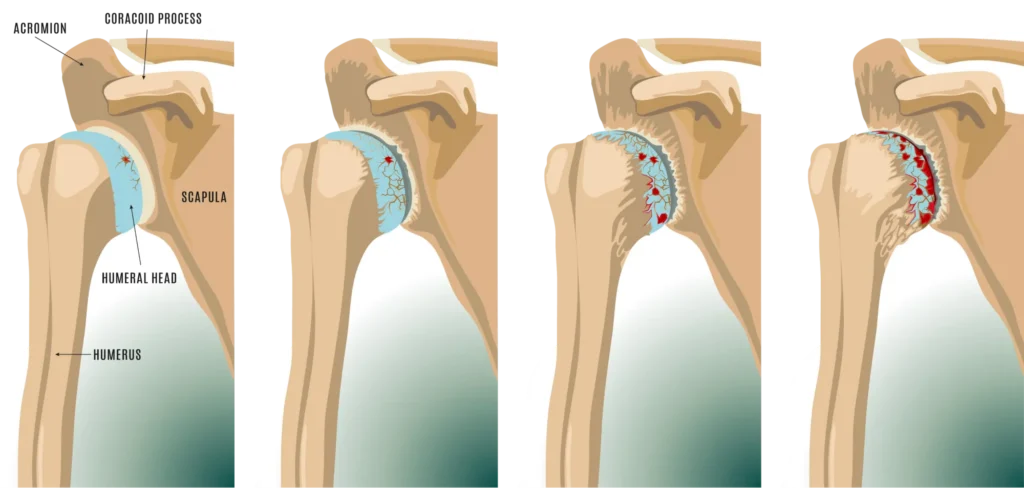
X-rays are typically enough to confirm the diagnosis and establish the severity. MRI may be ordered to assess the condition of the rotator cuff, which becomes relevant both for treatment planning and for any future surgical discussion.
Non-Surgical Treatment Options
Activity modification is usually the first and most important adjustment. Certain movements, particularly heavy overhead lifting, repetitive reaching, or activities that load the joint in an end-range position, tend to aggravate arthritis symptoms. Identifying and reducing those specific triggers, without eliminating activity altogether, often makes a meaningful difference. I’d rather help a patient modify how they do something than tell them to stop doing it entirely.
Physical therapy is one of the most consistently effective non-surgical interventions for shoulder arthritis. The goal isn’t to rebuild cartilage but to strengthen the muscles that support and stabilize the joint, preserve and improve range of motion, improve posture, and reduce the mechanical stress that aggravates symptoms. Patients who engage consistently with a structured program may see improvement that outlasts any single injection or medication.
Anti-inflammatory medications can reduce the inflammatory component of arthritis pain and improve day-to-day comfort. They’re most useful for managing flares and for patients with mild to moderate symptoms. Long-term use at high doses carries risks that need to be weighed against the benefit, and I discuss those tradeoffs individually with patients.
Corticosteroid injections deliver anti-inflammatory medication directly into the joint and can provide significant relief for weeks to months. They’re a practical option when oral medications aren’t sufficient or when a patient needs more targeted relief. The duration of benefit varies, and repeated injections over time are used thoughtfully. They’re not a permanent solution, but they can extend the period of effective non-surgical management meaningfully.
Other injection options: In select cases, regenerative approaches, may be appropriate for certain patients. These aren’t right for everyone, and I’m careful to match the treatment to the clinical picture rather than applying them broadly.
What Makes Non-Surgical Treatment Work
The patients who get the most sustained benefit from non-surgical management tend to have a few things in common. They’re consistent with physical therapy, not just through the initial course, but as an ongoing part of how they manage their shoulder. They modify the activities that aggravate symptoms rather than pushing through pain. And they come back for follow-up rather than waiting until things have gotten worse.
Severity matters, too. Mild to moderate arthritis with preserved joint space responds much better to conservative care than end-stage disease with significant bone-on-bone contact. This is one reason early evaluation is useful. The options available at an earlier stage are broader than what’s available once the arthritis has progressed substantially.
When Surgery Becomes the Right Conversation
As arthritis progresses, non-surgical treatment eventually reaches its limits for some patients. The signs that it’s time to revisit the surgical conversation typically include persistent pain that’s no longer controlled by conservative measures, significant loss of function affecting daily activities, and imaging that shows advanced joint damage.
At that point, total shoulder replacement (or reverse shoulder replacement for patients whose rotator cuff is also compromised) may become an option. Both procedures have strong outcomes data and can provide reliable pain relief and functional restoration. But reaching that conversation doesn’t mean conservative care failed; it means it did its job for as long as the biology allowed.
Summary
Shoulder arthritis is manageable, and for many patients, it can be managed well without surgery for a long time. The key is combining the right treatments, staying consistent, and adjusting the plan as the shoulder changes over time.
If you’re in the Portland, Tualatin, or Oregon City area and dealing with shoulder pain or stiffness that you suspect might be arthritis, an evaluation can confirm the diagnosis and help you understand exactly what your options are. There’s a lot that can be done before surgery becomes the conversation, and knowing where you stand is the first step.
You can request an appointment online or call the office at (503) 656-0836.
Frequently Asked Questions
How often can I get cortisone injections?
There’s no universal limit, but I approach repeated injections thoughtfully. Frequent high-dose corticosteroid injections over time can affect the soft tissue around the joint, and the benefit from each injection may diminish with repeated use. The frequency and timing are decisions I make on an individual basis.
Is exercise good or bad for shoulder arthritis?
Exercise, depending on the type, can be beneficial. Strengthening the muscles that support the shoulder joint reduces the load on the damaged cartilage and helps preserve function. The key is identifying which activities aggravate symptoms and adjusting accordingly, rather than stopping exercise altogether. Physical therapy is a good place to establish what’s safe and useful for a specific patient’s anatomy and arthritis pattern.
How do I know when it’s time to consider surgery?
The main signals are pain that is no longer controlled by conservative measures and functional limitations that are significantly affecting daily life (things like being unable to sleep through the night, dress without pain, or perform basic overhead tasks). If you’re at that point, it’s worth coming in for a conversation. Surgery isn’t the only option we’ll discuss, but it deserves to be on the table when non-surgical treatment has reached its limits.