Medically reviewed by Nathan Orvets, MD | Reviewed May 2026
Patients who come to me with severe shoulder pain and limited mobility often arrive with one key question already in mind: is there a point where the shoulder is too damaged to help? The honest answer is that for most patients, even those with very significant joint damage, there are great treatment options, and reverse shoulder replacement has become a common procedure I offer for the right candidates.
Understanding who benefits most from a reverse shoulder replacement means understanding what makes the procedure different from a traditional total shoulder replacement, and what specific conditions it’s designed to address. Not every patient with shoulder pain needs it. The candidacy decision is more nuanced than that.
Key Takeaways
- Reverse shoulder replacement works by switching the position of the ball and socket, allowing the deltoid muscle to power shoulder movement when the rotator cuff can no longer do so.
- The most common candidates have rotator cuff tear arthropathy, massive irreparable rotator cuff tears, or severe glenohumeral arthritis with bone erosion, particularly when combined with cuff deficiency.
- Age, activity level, and bone quality all factor into the candidacy decision.
What Is Reverse Shoulder Replacement?
In a standard anatomic shoulder, the ball (humeral head) sits on top of the humerus and fits into the socket (glenoid) of the shoulder blade. The rotator cuff muscles and tendons wrap around the joint and are responsible for most shoulder movement.
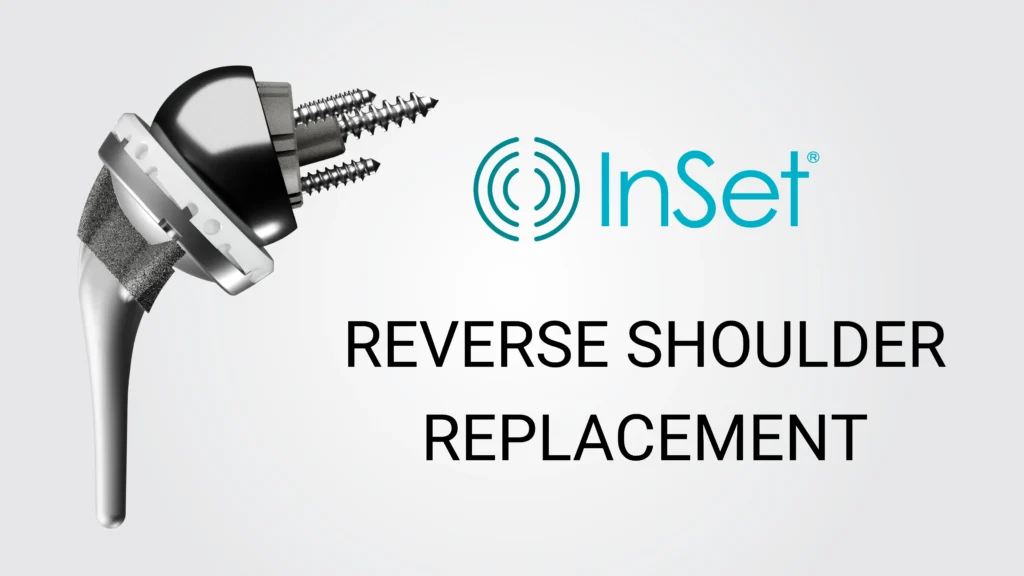
In a reverse shoulder replacement, the positions of the ball and socket are deliberately switched. The ball component is placed on the glenoid side, and the socket is placed on the humeral side. This configuration shifts the mechanical responsibility for shoulder movement from the rotator cuff, which in these patients is damaged or absent, to the deltoid muscle, which remains functional.
The result is a joint that can generate shoulder elevation and rotation even without a working rotator cuff. That’s what makes reverse shoulder replacement uniquely effective for conditions where the rotator cuff is irreparably compromised: it bypasses the damaged tissue entirely and rebuilds the mechanics around a muscle that isn’t affected.
What I See in My Practice
The patients I evaluate for reverse shoulder replacement tend to fall into a few overlapping categories. Many have been managing shoulder pain for years, trying injections, physical therapy, and activity modification, and have reached the point where none of those measures are providing meaningful relief. Some have already had prior shoulder surgery that didn’t fully resolve the underlying problem. A smaller group comes in after a complex fracture that isn’t amenable to standard repair.
What they share is a combination of significant pain and functional limitation that’s affecting their quality of life in real, daily ways. Getting dressed, sleeping through the night, reaching overhead, carrying groceries: these are the things patients describe losing. When the imaging confirms the structural damage matches the clinical picture, reverse shoulder replacement may be considered.
One thing I try to be direct about in these conversations: the procedure works best when patients understand what they’re committing to on the rehabilitation side. Surgery addresses the structural problem. Recovery is what restores the function.
The InSet® System
For most reverse shoulder replacement procedures, I use the InSet® Reverse Shoulder system developed by Shoulder Innovations. The design philosophy behind InSet® is focused on making a reverse shoulder behave as much like an anatomic shoulder as possible, which addresses one of the longstanding challenges of the procedure. The system uses a lateralized glenoid and lateralized humerus construct, which helps optimize rotational capacity and can position the shoulder’s anatomy in a way that supports better post-operative motion. The goal is to maximize what remains of the patient’s native anatomy rather than working around it, which matters both for range of motion and for long-term outcomes.
The InSet® system also includes options that allow for bone-preserving stem designs and a range of configurations to accommodate differences in individual anatomy. For my patients, this means the implant can be tailored to their specific shoulder rather than requiring the anatomy to fit a fixed implant design.
Who Is a Good Candidate?
The candidacy decision involves several factors, and I evaluate them together rather than using any single criterion as a yes or no threshold.
Rotator cuff tear arthropathy is the most common indication. This is a condition where a massive rotator cuff tear has been present long enough that the humeral head has migrated upward, damaged the surrounding bone, and the joint has developed arthritis as a result. The combination of cuff failure and joint destruction means a traditional replacement won’t restore reliable motion. Reverse replacement is designed for exactly this situation.
Massive irreparable rotator cuff tears without severe arthritis can also be an indication, particularly when the shoulder has developed what’s called pseudo-paralysis, or the inability to actively raise the arm even though passive motion is relatively preserved. In these cases, reverse replacement can restore active elevation when nothing else can.
Severe glenohumeral arthritis, particularly when conservative treatment has failed and the rotator cuff is also compromised or at risk, is another appropriate indication. When the cuff is intact and the anatomy is favorable, a total shoulder replacement may be the better option, but for patients where cuff integrity is uncertain or already failing, reverse replacement offers more predictable long-term function. Similarly, if severe arthritis has led to significant bone erosion, a reverse shoulder replacement can be the most reliable option to restore function and minimize pain.
Complex proximal humerus fractures in older patients, where the anatomy is too disrupted for reliable internal fixation, may also be managed with reverse shoulder replacement as a primary treatment.
Age and bone quality matter as well. Most candidates are over 60, and the procedure is generally reserved for patients who have exhausted appropriate non-surgical options. In younger patients, the decision involves a more careful conversation about long-term implant durability and the realistic demands they’ll place on the joint.
Who Is Not the Right Candidate?
Reverse shoulder replacement is not appropriate for every patient with a painful shoulder, and part of my role in these consultations is being clear about when it isn’t the right answer.
Patients with active infection, inadequate bone stock to support the implant, or medical conditions that significantly increase surgical risk may not be appropriate candidates. Patients with intact rotator cuffs and isolated arthritis may be better served by a traditional total shoulder replacement.
Patients with mild to moderate symptoms who haven’t tried conservative options, including physical therapy, anti-inflammatory medications, and injections, should plan to exhaust those before considering surgery. Reverse shoulder replacement is an option, but it’s also a procedure with a real rehabilitation commitment, and it makes sense only when the clinical picture supports it.
What to Expect from Recovery
Recovery after reverse shoulder replacement follows a structured progression. The arm is briefly immobilized in a sling for the first couple weeks to protect the repair and allow the soft tissue swelling to resolve.
Early physical therapy focuses on gentle passive motion, where the therapist moves the arm rather than the patient using their own muscles. Active motion and progressive strengthening begin as healing allows, typically around 2-3 weeks post-operatively. Most patients see meaningful improvement in pain within the first few months. Full functional recovery, including return to activities like reaching overhead, driving, and light sport, generally takes several months and continues to improve over the first year, sometimes longer.
The patients who tend to do best are those who commit to the full rehabilitation process and have realistic expectations about the timeline. Pain relief tends to come first; strength and range of motion develop more gradually.
Summary
Reverse shoulder replacement has become one of the most impactful procedures in my practice for patients who have reached the end of what conservative treatment can offer. The goal of the procedure is to offer meaningful pain relief, restored shoulder function, and a return to the daily activities that matter most.
If you’re in the Portland area and dealing with severe shoulder pain, a known rotator cuff condition, or shoulder arthritis that hasn’t responded to conservative care, I’d encourage you to come in for an evaluation. A proper exam and imaging review will tell us whether reverse shoulder replacement is the right conversation to be having, or whether there’s another path that makes more sense for your specific situation.
You can request an appointment online or call the office at (503) 656-0836.
Frequently Asked Questions
How is reverse shoulder replacement different from total shoulder replacement?
A total shoulder replacement preserves the normal ball-and-socket orientation and depends on an intact rotator cuff to power movement. A reverse shoulder replacement switches the positions of the ball and socket, allowing the deltoid muscle to move the arm when the rotator cuff is damaged or absent. The choice between them depends primarily on the condition of the rotator cuff.
Will I be able to raise my arm above my head after surgery?
Many patients regain the ability to raise their arm overhead after reverse shoulder replacement, particularly those who had lost that ability due to rotator cuff tear arthropathy or pseudo-paralysis. The degree of overhead motion achieved depends on the specific condition, the quality of the deltoid muscle, and how well rehabilitation progresses.
Is the recovery painful?
Discomfort in the early post-operative period is expected and managed with medications and nerve blocks. Many patients find the pain becomes more manageable within the first week.