
If your shoulder has been gradually getting stiffer and more painful, and you’re not sure why, you may be dealing with a condition called frozen shoulder. Medically known as adhesive capsulitis, frozen shoulder is a condition that can progressively limit the shoulder joint’s ability to move. It tends to develop slowly, making everyday tasks like reaching overhead, putting on a jacket, or sleeping comfortably surprisingly difficult. In this post, we’ll break down what frozen shoulder actually is, who tends to develop it, what the symptoms look and feel like, and what treatment may involve.
Key Takeaways
- Frozen shoulder, or adhesive capsulitis, involves progressive pain and stiffness caused by thickening and tightening of the shoulder joint capsule.
- The condition typically moves through three stages: freezing, frozen, and thawing, each with its own characteristics.
- Non-surgical treatments such as physical therapy, anti-inflammatory medications, and corticosteroid injections may help manage symptoms for many patients.
- If shoulder pain and stiffness are interfering with your daily life, a consultation with a shoulder specialist is worth considering.
What Is Frozen Shoulder?
Frozen shoulder develops when the tissue surrounding the shoulder joint, known as the joint capsule, becomes inflamed, thickens, and tightens over time. This process may involve the formation of adhesions, which are bands of scar-like tissue that restrict the shoulder’s normal range of motion. The result is a shoulder that feels genuinely “stuck.”
The glenohumeral joint, the main ball-and-socket joint of the shoulder, depends on a flexible capsule to allow its remarkable range of movement. When that capsule contracts due to adhesive capsulitis, even simple motions like reaching behind your back can feel nearly impossible. The shoulder doesn’t just hurt; it literally loses its ability to move freely in multiple directions.
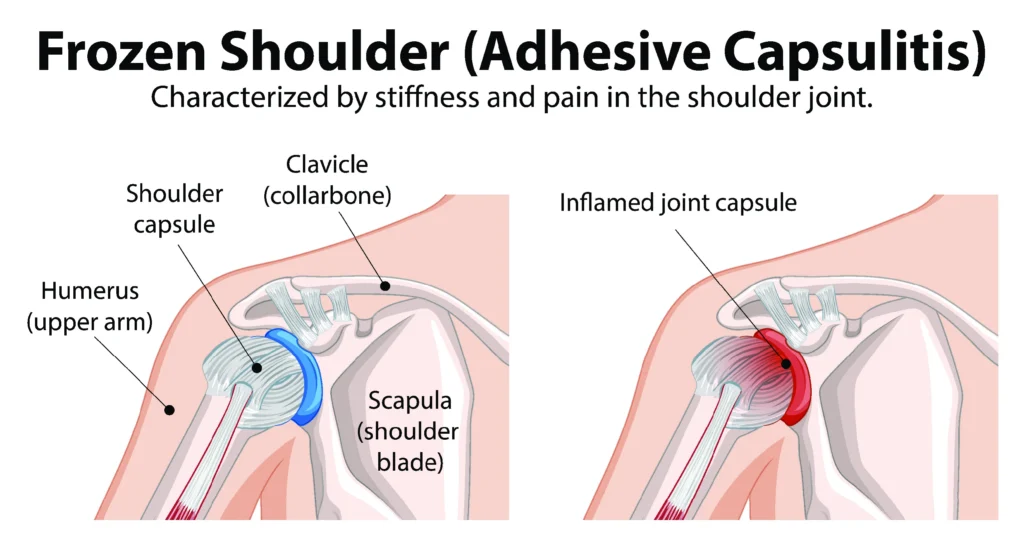
While the precise cause isn’t always clear, frozen shoulder commonly develops after a period of shoulder immobility. This can follow a surgery, a fracture, or even a minor injury that led to prolonged rest. In some cases, the condition appears without any obvious trigger, which makes it particularly confusing for patients experiencing it for the first time.
Who Is at Risk?
Frozen shoulder can affect a wide range of people, but certain groups appear to face a higher likelihood of developing it. Recognizing these risk factors may help you understand whether your shoulder symptoms deserve closer attention.
Age and gender play a role. The condition most commonly develops in people between 40 and 60 years old, and it tends to occur somewhat more frequently in women than in men. Additionally, diabetes is one of the most consistently identified risk factors for frozen shoulder.
Other conditions and circumstances that may increase risk include:
- Thyroid disorders, both overactive and underactive
- Cardiovascular disease or a history of cardiac procedures
- Parkinson’s disease
- Prior shoulder injury or surgery
- Extended periods of shoulder or arm immobilization
If you have any of these risk factors and notice increasing shoulder stiffness or discomfort, speaking with an experienced shoulder specialist sooner rather than later may be worthwhile.
The Three Stages of Frozen Shoulder
One of the more distinctive aspects of this condition is that it tends to follow a predictable progression. Frozen shoulder is typically described as a three-stage process, and understanding those stages can help set realistic expectations for recovery.
Stage 1: Freezing
This is generally the most painful stage. During the freezing phase, shoulder pain gradually intensifies, sometimes without a clear injury or event to explain it. The pain tends to worsen at night and may radiate down the upper arm. As pain increases, range of motion begins to decline.
Stage 2: Frozen
In the frozen stage, pain may begin to stabilize or ease somewhat, but stiffness becomes the dominant issue. The shoulder may feel firmly restricted, and activities requiring overhead reach or behind-the-back movement become markedly limited. Although the intensity of pain often decreases, the functional limitation during this phase can be just as disruptive to daily life.
Stage 3: Thawing
During the thawing phase, range of motion gradually returns. The timeline varies considerably between individuals. Appropriate treatment during this stage, particularly consistent physical therapy, may help support a more complete recovery.
How Is Frozen Shoulder Diagnosed?
When you see a specialist and present with shoulder stiffness and pain, the evaluation typically begins with a careful physical examination. Your doctor will assess your shoulder’s range of motion in multiple planes, both actively and passively, and note any areas of tenderness or restriction.
Imaging may also be part of the process. X-rays are often ordered to rule out arthritis, calcifications, or bony changes that might explain your symptoms. Frozen shoulder itself doesn’t typically appear on an X-ray, but the images help eliminate other potential causes. An MRI may occasionally be recommended to evaluate the soft tissues and rule out conditions like a rotator cuff tear, which can sometimes coexist with or mimic frozen shoulder.
In many cases, the diagnosis is largely clinical, meaning it’s based primarily on the pattern of your symptoms and the characteristic findings during the physical exam. Your history, how the symptoms developed over time, and which specific movements are restricted all contribute to reaching an accurate diagnosis.
Treatment Options
Treatment for frozen shoulder is typically tailored to your stage, your symptom severity, and how the condition is affecting your life. The overall goals are to manage pain, gradually restore motion, and support a return to the activities you care about.
Physical Therapy
Physical therapy is often a component of frozen shoulder treatment. A skilled therapist can guide you through specific stretching and mobility exercises designed to progressively restore range of motion without aggravating inflammation. The approach tends to shift as you move through the stages, with earlier sessions focusing more on pain control and gentle movement, and later sessions shifting toward more active range-of-motion and strengthening work. Consistency matters. Patients who commit to their home exercise program between sessions are helping to support better outcomes.
Medications
Nonsteroidal anti-inflammatory drugs (NSAIDs) like ibuprofen or naproxen can help manage pain and reduce inflammation, particularly in the early stages. Over-the-counter formulations are commonly used.
Corticosteroid Injections
Steroid injections administered directly into the shoulder joint may reduce pain and inflammation, especially during the freezing stage when pain tends to be most intense. While injections are generally not a long-term solution on their own, they can provide enough relief to allow more meaningful participation in physical therapy.
Hydrodilatation
This procedure involves injecting a mixture of fluid, typically saline combined with a corticosteroid and local anesthetic, into the joint capsule. The goal is to help stretch and expand the tightened capsule from within. Some patients find this approach helpful when more conservative measures haven’t provided adequate relief, though individual results can vary.
Arthroscopic Capsular Release
For patients who don’t respond sufficiently to non-surgical care, surgery may be considered. Arthroscopic capsular release is a minimally invasive procedure in which a surgeon uses small instruments and a camera to carefully release the tight portions of the joint capsule. This approach may help restore motion more efficiently than waiting for the natural thawing process alone. Recovery typically involves a structured physical therapy program beginning shortly after the procedure to preserve the gains made in the operating room.
When Should You See a Specialist?
Shoulder stiffness that persists beyond a few weeks, especially when it’s accompanied by significant pain or an inability to perform normal daily activities, may be worth having evaluated. The earlier frozen shoulder is identified, the sooner a targeted treatment plan can begin. Waiting through months of worsening stiffness without guidance can sometimes make recovery more difficult. Whether non-surgical management is the right path or a more interventional approach may be appropriate, the aim is always to help you move better and feel better.
Summary
Frozen shoulder is a challenging condition. It can develop quietly and linger for months, gradually making even small daily movements feel like a bigger deal than they should be. But it is also a condition that often responds well to treatment, and one that most patients do recover from, even if the timeline takes longer than anyone would prefer. Understanding the stages, recognizing the symptoms early, and seeking appropriate care can meaningfully influence how your recovery unfolds.
Frequently Asked Questions
Is frozen shoulder the same as a rotator cuff tear?
No, these are two distinct conditions. A rotator cuff tear involves damage to the tendons that stabilize and move the shoulder, while frozen shoulder is caused by thickening and tightening of the joint capsule itself. Both can cause pain and stiffness, but they differ in their underlying mechanism and treatment approaches. A thorough evaluation, including physical examination and potentially imaging, helps distinguish between the two.
Does frozen shoulder come back after treatment?
Recurrence in the same shoulder is relatively uncommon, though it can happen. There may be a somewhat higher likelihood of developing the condition in the opposite shoulder at some point, particularly in individuals with underlying risk factors like diabetes. Monitoring for early symptoms and addressing them promptly may help limit the impact of any future occurrence.
How long does recovery from frozen shoulder typically take?
Recovery timelines vary considerably. Some patients notice meaningful improvement within a few months of beginning treatment, while others may take a year or more to regain full or near-full range of motion. Factors such as the stage at which treatment began, consistency with physical therapy, and the presence of underlying health conditions can all influence how recovery progresses.