
Medically reviewed by Nathan Orvets, MD
Every spring, families come into my clinic with the same worried look. Their pitcher felt a pop on the inside of the elbow, or the velocity quietly disappeared, and someone on the team has already said the words “Tommy John surgery.” That name carries a lot of weight in baseball, and it carries a fair number of myths, too. Tommy John surgery is the common name for ulnar collateral ligament (UCL) reconstruction. In this procedure, a torn ligament on the inner elbow is replaced with a tendon graft. In this post, I’ll explain what the UCL does, how it gets hurt, when I think surgery makes sense, and what the long road back to throwing usually looks like.
Key Takeaways
- The UCL is a small ligament on the inner elbow that helps hold the joint together every time you throw.
- Many partial UCL injuries may improve with rest and a structured rehab program, so surgery is not automatic.
- Tommy John surgery replaces the damaged ligament with a tendon graft, usually taken from the forearm or the back of the knee. Grafts can also be obtained from tissue donors.
- Rehabilitation after UCL reconstruction typically takes 10 to 14 months, and pitchers may need longer before they’re back on the mound.
What the UCL Does
The ulnar collateral ligament sits on the inside of your elbow, the side closest to your body. It connects the humerus (upper arm bone) to the ulna, one of the two bones in your forearm. During everyday life, it doesn’t have to work very hard.
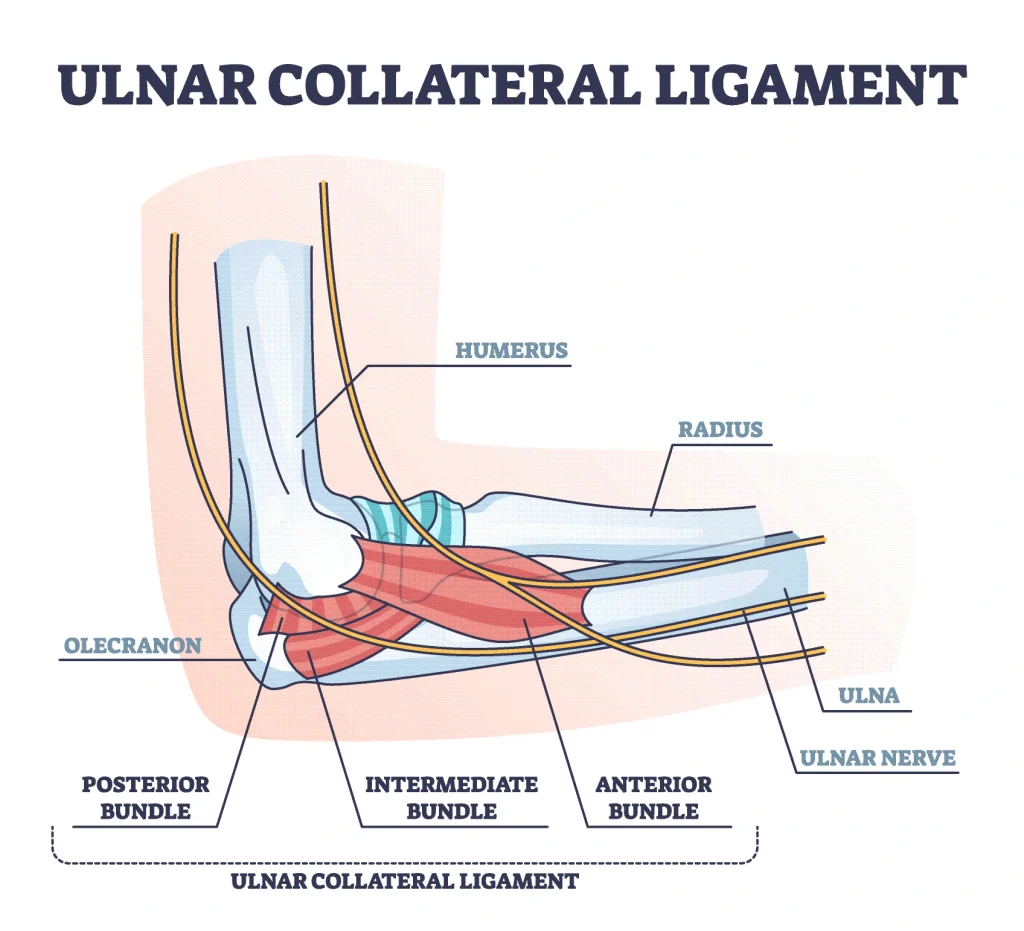
Throwing changes that. As a pitcher cocks the arm back and then whips it forward, the forearm lags behind the upper arm. That motion tries to pry the inner elbow open, and the UCL is the main structure resisting it.
Before medicine, I studied engineering, so I tend to think about the elbow in terms of loads and repetition. A ligament can handle one hard throw without any trouble and but it can fail after thousands of repetitions. It’s a bit like bending a paperclip back and forth. No single bend breaks it, but the damage adds up.
How UCL Injuries Happen
Most UCL tears build slowly. Repetitive throwing creates small amounts of damage that the ligament doesn’t fully recover from between outings. Eventually, the ligament stretches out or tears. Less often, the tear happens all at once, and the athlete feels a sharp pop on a single throw.
Pitchers carry the highest risk, but I also see UCL injuries in catchers, infielders, javelin throwers, and volleyball players. A fall that dislocates the elbow can injure the UCL in anyone, athlete or not. If you want a deeper look at why baseball is so tough on the arm, I cover it in my post on throwing elbow injuries in baseball players.
A few signs tend to point toward the UCL. The first is pain on the inner elbow during the late cocking phase or at release. The second is a drop in velocity or control that doesn’t bounce back with rest. Third, some throwers notice tingling in the ring and pinky fingers. That happens because the ulnar nerve runs right next to the ligament and can get irritated along with it.
How I Diagnose a UCL Tear
Diagnosis starts with a hands-on exam. I check for tenderness directly over the ligament and use specific stress tests that recreate the throwing motion. X-rays help me look for bone spurs, loose fragments, or growth plate problems in younger players. An MRI, sometimes with contrast injected into the joint, can show whether the tear is partial or complete and where it is located.
That said, an MRI alone doesn’t decide surgery for me. I weigh the images alongside how the elbow feels, how it moves, and what the athlete needs it to do.
When Surgery Isn’t the First Step
For many partial UCL tears, I start with a nonsurgical plan. That usually means a period of rest from throwing, followed by physical therapy. Therapy focuses on the forearm muscles that sit over the ligament and help protect it, plus the shoulder, core, and hips. Once the elbow is calm and strong, the athlete moves into a gradual interval throwing program.
I also want to be clear about something. Non-throwing athletes and most adults who don’t play overhead sports can often live and work normally without a reconstructed UCL. Daily life rarely stresses the ligament the way pitching does.
My Approach to Tommy John Surgery
I generally recommend Tommy John surgery for complete UCL tears in athletes who want to return to competitive throwing. I also consider it for partial tears that haven’t improved after a well-run rehab program. One opinion I share with every family: this surgery is not a way to throw harder. It treats a damaged ligament. It’s not a performance upgrade, and I don’t recommend it for a healthy elbow.
During UCL reconstruction, I take a tendon graft, typically the palmaris longus from the forearm. Not everyone has that tendon, so a hamstring tendon from the back of the knee or a sterilized tendon graft from a tissue donor are common alternatives. I drill small tunnels in the humerus and ulna, pass the graft through them, and secure it under the right tension to recreate the ligament. The ulnar nerve is protected throughout. If it was causing symptoms before surgery, I may move it to a better position.
For some younger athletes, a UCL repair may be an option instead. This applies when the ligament has pulled off the bone but is otherwise healthy, and the repair is often reinforced with a strong suture. Recovery after a repair can be shorter than after reconstruction for the right patient. Many tears don’t meet those criteria, though, and reconstruction remains the standard for a worn-out ligament.
Like most of my outpatient procedures, UCL surgery typically allows patients to go home the same day. I build the pain plan around a nerve block and non-opioid medications when possible.
What Recovery Looks Like After UCL Reconstruction
Recovery timelines for Tommy John surgery vary by athlete and protocol, but the general shape looks like this:
- The first several weeks: The elbow starts in a splint, then moves to a hinged brace. Motion returns gradually, and the wrist, hand, and shoulder stay active.
- Roughly months two through four: Strengthening builds through the forearm, shoulder, core, and legs. No throwing yet.
- Around four to six months: Many athletes begin an interval throwing program, starting with short, easy tosses on flat ground.
- Later in the first year: Throwing distance and effort increase step by step. Pitchers progress back to the mound.
Many athletes need about 10 to 14 months of rehab before returning to competition. Pitchers may need longer, and a 12- to 18-month return is common for them.
What I See in My Patients
In the Portland area, I see many high school, club, and collegiate players who throw almost year-round, moving from spring ball to summer teams to fall showcases. That schedule leaves the elbow very little time to recover. When I trace a UCL injury back, a crowded calendar is often part of the story.
After surgery, the athletes who struggle are often the ones who feel great at five months and start throwing harder than the program allows. A graft that feels strong still needs time to mature. Parents sometimes ask me if surgery will fix everything. My answer is honest: the operation gives the elbow a new ligament, but the rehab and the throwing habits afterward shape a lot of the outcome.
Summary
Tommy John surgery reconstructs a torn UCL with a tendon graft, and it has helped many throwers get back on the field. We covered what the ligament does, how it gets injured, when nonsurgical care makes sense, and why recovery usually takes the better part of a year. Surgery isn’t right for every UCL injury, and some partial tears may heal with a good rehab plan.
If your athlete has inner elbow pain, a sudden drop in velocity, or tingling into the ring and pinky fingers, stop throwing and get the elbow checked. You can request an appointment at our Tualatin or Oregon City office, and we’ll build a plan around your athlete’s goals.
Frequently Asked Questions
How long does it take to recover from Tommy John surgery?
Many athletes need about 10 to 14 months of rehab before returning to competition after UCL reconstruction. Pitchers may need longer, commonly 12 to 18 months. For select younger athletes who qualify for a UCL repair instead of a reconstruction, the return can be shorter.
Does Tommy John surgery make you throw harder?
No. This is a common myth. Tommy John surgery treats a damaged ligament. Any velocity gains after recovery usually come from months of dedicated strength training and mechanics work, which a healthy athlete could do without surgery.
Can a UCL tear heal without surgery?
Many partial tears may improve with rest, physical therapy, and a gradual throwing program. Complete tears in competitive throwers often don’t heal well enough to handle pitching again. Non-throwers can frequently do well without surgery.
Where does the graft come from?
The graft is often the palmaris longus tendon from the forearm. Some people don’t have this tendon, so a hamstring tendon from the back of the knee is a common alternative. Losing either tendon generally has little noticeable effect on everyday strength.
Is Tommy John surgery only for pitchers?
No. Pitchers make up the largest group, but catchers, position players, javelin throwers, and other overhead athletes may need it too. It may also be considered after an elbow dislocation damages the ligament in a patient with high demands on the arm.
