
Medically reviewed by Nathan Orvets, MD | Reviewed May 2026
If you’ve been dealing with elbow pain that flares when you grip a coffee mug, shake someone’s hand, or swing a club, you may have come across the terms lateral epicondylitis vs. medial epicondylitis. I see both conditions regularly in my practice in the Portland area, and one of the most common things patients tell me is that they didn’t realize there were two distinct versions of this problem until their elbow was already affecting their daily life. Getting the right diagnosis is what leads to the right treatment, and that starts with understanding what’s actually happening in the elbow.
Key Takeaways
- Lateral epicondylitis (tennis elbow) affects the outer elbow, and medial epicondylitis (golfer’s elbow) affects the inner elbow.
- The two conditions can look similar, but they tend to affect different populations and activities, and they respond to different treatment approaches.
- Most patients respond well to non-surgical care, including rest, physical therapy, and targeted strengthening exercises.
- If symptoms persist beyond several weeks despite conservative treatment, an evaluation with an experienced elbow specialist may be the right next step.
The Basics: What Are These Conditions?
Both lateral and medial epicondylitis are forms of tendinopathy, a breakdown or irritation of the tendon tissue that connects the forearm muscles to the bony prominences on the outside (lateral) and inside (medial) of the elbow.
Lateral epicondylitis, commonly called tennis elbow, involves the tendons on the outer side of the elbow. The extensor carpi radialis brevis is the tendon most commonly affected. Repetitive gripping, twisting, or lifting movements cause small tears and degenerative changes in this tissue over time, producing pain and weakness around the outer elbow.
Medial epicondylitis, or golfer’s elbow, involves the tendons on the inner side. The flexor-pronator muscles attach at the medial epicondyle and take stress from activities that require repeated wrist flexion and forearm rotation. Despite the familiar nicknames, you don’t have to play tennis or golf to develop either of these conditions.
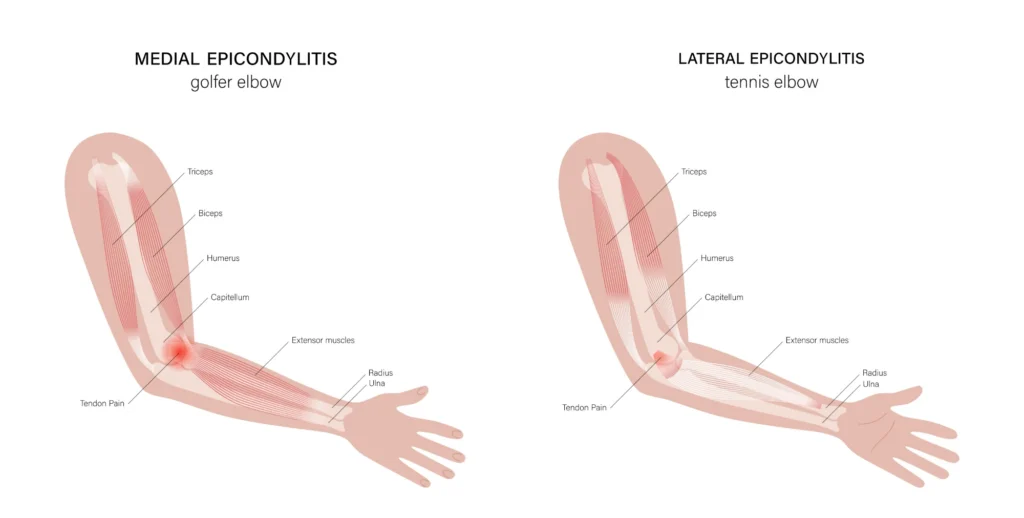
Despite their similarities, lateral and medial epicondylitis behave differently, and mixing them up can send a patient down the wrong treatment path.
Who Develops These Conditions, and Why?
Lateral epicondylitis is more common than its medial counterpart. It tends to affect people between the ages of 35 and 55 and frequently shows up in recreational tennis players, particularly those with grip or technique issues, as well as painters, carpenters, plumbers, and anyone doing repetitive gripping or tool use. Even prolonged mouse and computer work has been linked to it.
Medial epicondylitis develops from different mechanics. Golfers with swing or grip issues, baseball pitchers, bowlers, and workers who lift frequently with a pronated wrist are at elevated risk. Rock climbers and masons also show up in my office with this diagnosis more than most people might expect.
One thing that can make both conditions tricky to sort out: they can occur simultaneously, especially in athletes who throw overhead or perform complex, repetitive forearm movements. The elbow doesn’t always read the textbook.
What I See in My Patients
When someone comes into my office with elbow pain, the first thing I ask them to do is point to exactly where it hurts. That one detail can tell me a great deal. Outer elbow tenderness that worsens with gripping points in one direction; inner elbow tenderness that’s worst on wrist flexion points somewhere else entirely. Confirming this on physical examination is the most important part of the evaluation.
Most of the tennis elbow patients I see waited a while before coming in. They tried rest, maybe an over-the-counter brace, and assumed the pain would eventually go away. Sometimes it does. But when I see someone who’s been dealing with lateral elbow pain for three months or more with no improvement, I know we’re past the point where passive rest alone is going to get the job done.
Here in the Portland area, I also see a lot of patients who work physically demanding jobs like construction and landscaping, where taking two weeks off isn’t a realistic option. That changes the treatment conversation. We have to find ways to reduce the load on the tendon while keeping them functional at work. That challenge is actually one of the things I genuinely enjoy about treating patients: the plan has to fit the patient’s real life, not just the diagnosis on paper.
Diagnosis
Diagnosing lateral vs. medial epicondylitis is largely a clinical process, meaning the history and the physical exam do most of the heavy lifting. I use several provocative tests to confirm which side is involved and to rule out other causes, like a pinched nerve in the neck or elbow (which can mimic both conditions) or ligament (UCL) pathology on the inner side.
Imaging plays a supporting role. X-rays can rule out bony abnormalities or calcifications. Ultrasound can show tendon thickening or partial tearing in real time, which I find especially useful for visualizing what’s happening in the tendon itself. MRI may be ordered when symptoms are severe, persistent, or when I want a clearer picture of the degree of tendon damage.
My Approach to Treatment
For most patients with lateral or medial epicondylitis, I start with a well-structured, non-operative plan. The large majority of people with either of these conditions can manage their symptoms effectively with the right conservative program. Here’s what that typically looks like in my practice:
- Activity modification: This means reducing the specific movements that load the irritated tendon. For most patients, it doesn’t mean stopping all activity; it means being strategic about which activities to temporarily scale back.
- Physical therapy: A targeted eccentric strengthening program has the strongest evidence behind it for tendinopathy.
- Counterforce bracing: A forearm strap worn just below the elbow can offload the tendon attachment and reduce pain with activity. It’s not a cure, but it can help patients stay more functional while they work through rehab.
- PRP (platelet-rich plasma): For patients with chronic, refractory symptoms who have already tried other conservative treatments, I may discuss PRP injections as a next step. The evidence continues to evolve, but some patients do respond well.
If symptoms persist despite consistent, well-executed conservative treatment, surgical debridement of the degenerative tendon tissue can be considered. Arthroscopic approaches are available and generally allow for a faster recovery than open procedures. I don’t take that step lightly, but for patients who have truly exhausted non-operative options, surgery can provide meaningful relief.
When Should You See a Doctor?
A little elbow soreness after a long day in the garden or an aggressive round of golf isn’t unusual. But certain patterns suggest it’s worth getting an evaluation:
- Pain that persists beyond a few weeks despite rest and activity modification
- Grip weakness that’s starting to affect work, sport, or daily tasks
- Numbness or tingling in the fingers alongside elbow pain
- Pain severe enough to interfere with sleep or your ability to do your job
- Swelling or bruising around the elbow joint that doesn’t resolve
Coming in for an early evaluation doesn’t commit you to treatment. Often it just means getting a clear answer about what’s going on so you can make an informed decision. That’s the kind of conversation I have with patients every day, and it’s a much better place to start than months of guessing.
Summary
Lateral vs. medial epicondylitis may seem like a minor anatomical distinction, but knowing which side of the elbow is involved, and what’s actually driving the pain, shapes everything about how we approach care. Both conditions are common, both are treatable, and most patients do not need surgery to get better. If you’ve been pushing through elbow pain and waiting for it to improve on its own, that’s a natural first instinct. But if you’ve crossed the three-to-four-week mark without meaningful improvement, it may be time to stop guessing and get a proper evaluation. Request an appointment at my office in Tualatin or Oregon City, and let’s figure out exactly what’s going on and how to address it.
Frequently Asked Questions
Can you have both tennis elbow and golfer’s elbow at the same time?
Yes, and it happens more than most people expect. Overhead athletes, rock climbers, and people who perform complex, repetitive forearm movements can develop irritation on both sides of the elbow simultaneously. If pain is present on both the inner and outer elbow, a thorough examination can sort out what’s contributing on each side.
How long does it take to recover from lateral or medial epicondylitis?
Recovery timelines can vary quite a bit depending on how long symptoms have been present, how consistently you follow a rehab program, and whether you’re able to modify the activities that aggravate the tendon. Mild cases may resolve within a few weeks. More chronic or severe cases can take several months of dedicated treatment. In some cases, symptoms can persist for over a year!
When is surgery actually necessary for epicondylitis?
Surgery is typically considered when symptoms have persisted despite consistent conservative treatment, or when imaging shows significant tendon damage unlikely to respond to therapy alone. If you’re wondering where you fall on that spectrum, the best first step is a proper evaluation.