
Medically reviewed by Nathan Orvets, MD
If your shoulder has been getting stiffer and more painful over several months, and there’s no injury to explain it, frozen shoulder is one of the first conditions I consider. Medically known as adhesive capsulitis, frozen shoulder slowly limits how far the arm moves, until reaching overhead, fastening a seatbelt, or sleeping on that side becomes a daily struggle. It also tends to appear in a specific window of life, between roughly 40 and 60, and more frequently in women.
Key Takeaways
- Frozen shoulder happens when the capsule around the shoulder joint thickens and tightens, causing pain and a gradual loss of motion.
- The hormonal shifts of perimenopause and menopause may play a role, which could help explain why women in midlife are affected more frequently.
- Many patients improve with nonsurgical care like physical therapy and injections, and surgery is an option when stiffness doesn’t respond.
What Is Frozen Shoulder?
Frozen shoulder develops when the joint capsule, the tissue that surrounds the shoulder’s ball-and-socket joint, becomes inflamed, thickens, and tightens. Bands of scar-like tissue called adhesions sometimes form inside it. The result is a shoulder that feels stuck.
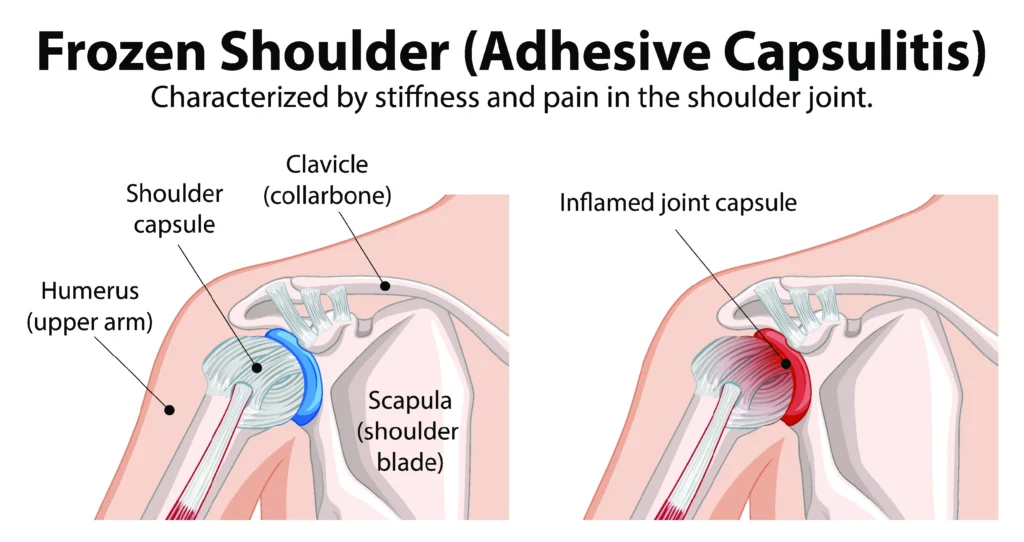
The glenohumeral joint depends on a loose, flexible capsule for its wide range of motion. When that capsule contracts, simple motions like reaching behind your back feel nearly impossible. The shoulder doesn’t just hurt. It loses the ability to move freely in several directions, even when someone else tries to move the arm for you.
The exact cause isn’t always clear. Frozen shoulder commonly follows a period of immobility after surgery, a fracture, or an injury that led to prolonged rest. In other cases it appears with no obvious trigger, which makes it confusing the first time it happens.
Who Is at Risk?
Frozen shoulder most commonly affects people between 40 and 60, and women more than men. Diabetes is one of the most consistent risk factors, and people with diabetes tend to have more stubborn stiffness.
Other conditions and circumstances linked to a higher risk include:
- Thyroid disorders, both overactive and underactive
- Diabetes
- Heart disease or Parkinson’s disease
- A prior shoulder injury or surgery
- Long periods of arm immobilization
Frozen Shoulder, Perimenopause, and Menopause
The age range for frozen shoulder lines up closely with perimenopause and menopause, and researchers are studying whether that overlap is more than a coincidence. Estrogen helps regulate inflammation and supports the health of connective tissue, including tendons, ligaments, and joint capsules. As estrogen levels swing and then decline, the shoulder capsule could become more prone to the inflammation and thickening behind frozen shoulder.
A 2024 review in the journal Climacteric groups frozen shoulder with other estrogen-related joint and muscle problems under the term “musculoskeletal syndrome of menopause.” The research is still early, but the connection is worth taking seriously. If you’re in your 40s or 50s and your shoulder has been getting stiffer for no clear reason, mention where you are in perimenopause or menopause at your visit.
Thyroid problems and blood sugar changes also show up more in midlife, and both raise the risk on their own.
The Three Stages of Frozen Shoulder
Frozen shoulder typically follows a recognizable pattern. Timelines may vary between patients, and the ranges below are approximate, but the condition generally moves through three stages.
- Freezing: Pain builds gradually and is frequently worse at night. Motion starts to slip away. For many patients, this stage lasts somewhere between six weeks and nine months.
- Frozen: Pain may ease, but stiffness takes over. Reaching overhead or behind the back becomes markedly limited. This phase often lasts roughly four to six months.
- Thawing: Motion slowly returns. Getting back to normal or near-normal may take six months to two years, and consistent therapy helps along the way.
How I Diagnose Frozen Shoulder
As a fellowship-trained shoulder and elbow surgeon, I start with a careful exam. I check how far your shoulder moves on its own and how far I can move it for you. In frozen shoulder, both are limited. With a rotator cuff problem, by contrast, I can often move the arm further than the patient can lift it on their own.
X-rays help rule out arthritis, calcium deposits, or bony changes, even though frozen shoulder itself doesn’t show up on them. An MRI is sometimes useful when I want to check for a rotator cuff tear, which may mimic frozen shoulder or occur alongside it. In most cases, though, the diagnosis comes from the pattern of your symptoms and what the exam shows.
What I See in My Patients
Patients with frozen shoulder have often been living with it longer than they’d like before they come in. Some first assumed they had strained something and rested it, which sometimes lets the stiffness settle in further. Others have had an injection or a few rounds of therapy already.
Midlife women make up a large share of these visits, and many are also dealing with poor sleep or aches in other joints. Frozen shoulder pain tends to be worst at night, so the two feed into each other. Naming that overlap early doesn’t change the core treatment, but it makes the whole experience easier to understand.
My Approach to Treatment
I’m cautious about rushing to surgery for frozen shoulder, because many patients improve with time and the right nonsurgical care. My goal is to manage pain, protect the motion you still have, and steadily win back the rest.
- Physical therapy: Gentle stretching and mobility work form the foundation. Early sessions focus on pain control, and later sessions shift toward more active motion and strengthening. Home exercises between visits matter as much as the sessions themselves.
- Anti-inflammatory medication: NSAIDs such as ibuprofen or naproxen may ease pain, especially in the freezing stage.
- Corticosteroid injection: An injection into the joint can calm inflammation when pain is at its worst, making therapy more productive.
- Hydrodilatation: For some patients, injecting fluid into the capsule helps stretch it from within when other measures haven’t provided enough relief.
When stiffness doesn’t respond to an extended trial of these treatments, arthroscopic capsular release may be a reasonable next step. Using a small camera and narrow instruments, I release the tightest portions of the capsule. As with other shoulder arthroscopy procedures, the work is done through small incisions. Therapy typically begins shortly after surgery to hold on to the motion gained in the operating room.
Shoulder stiffness that lasts more than a few weeks is worth having checked, especially with night pain or trouble with daily tasks. Starting treatment earlier could make the course easier to manage.
Summary
Frozen shoulder can develop quietly and linger for months. Most patients do recover, even when the timeline runs longer than anyone would like. Physical therapy, medication, and injections help many people, and arthroscopic release is an option when stiffness won’t budge. If your shoulder has been getting stiffer, request an appointment at my Tualatin or Oregon City office, and bring a note of when your symptoms started and any health or cycle changes around that time.
Frequently Asked Questions
Is frozen shoulder the same as a rotator cuff tear?
No. A rotator cuff tear involves damage to the tendons that move and stabilize the shoulder, while frozen shoulder comes from thickening and tightening of the joint capsule. Both cause pain and limited motion, so an exam, and sometimes imaging, helps tell them apart.
Can perimenopause cause frozen shoulder?
Perimenopause may contribute, but the research is still developing. Frozen shoulder peaks in the same years that estrogen levels shift, and estrogen helps regulate inflammation in connective tissue. Other midlife factors, like thyroid disease and diabetes, also play a part.
Does frozen shoulder come back after treatment?
Recurrence in the same shoulder is uncommon, though it can happen. Some people later develop it in the opposite shoulder, particularly those with risk factors like diabetes.
How long does recovery from frozen shoulder take?
Timelines vary. Some patients notice meaningful improvement within a few months of starting treatment, while others need a year or more to regain full or near-full motion. Left to run its course, frozen shoulder may take up to three years to fully resolve.
