
Medically reviewed by Nathan Orvets, MD | Reviewed May 2026
Athletes who use their arms repeatedly (pitchers, climbers, rowers, golfers, tennis players) place a lot of stress on the elbow over time. The structures most vulnerable to sports-related injury vary depending on the demands of the specific activity. A rock climber’s elbow problem looks different from a pitcher’s, even if both patients describe pain in the same general area.
The good news is that most elbow injuries in athletes respond well to treatment when they’re identified accurately and early. The challenge is that athletes can be reluctant to stop training, and the symptoms of many elbow conditions can be subtle at first, such as a gradual loss of power, a vague ache that fades with warmup, or a feeling that something just isn’t quite right. In this post, we’ll review the most common elbow injuries in athletes, along with my approach to treatment.
Key Takeaways
- Elbow injuries in athletes most commonly involve the tendons, ligaments, or nerves. These structures absorb the most stress during repetitive upper-extremity activity.
- The location of the pain is one of the most useful early clues: outer elbow, inner elbow, and back (posterior) elbow each point to different structures.
- Returning to sport too soon, or training through pain, is one of the most frequent reasons athletes end up needing more intensive treatment down the road.
What I See in My Practice
In the Pacific Northwest, I see a wide range of athletes in my practice, from competitive baseball players to weekend cyclists to serious rock climbers. The elbow injuries I treat most often fall into a few consistent patterns, and what’s interesting is how closely the injury type tracks with the sport.
Overhead throwers, pitchers especially, tend to show up with inner elbow pain and some degree of UCL involvement. Climbers and rowers more often present with lateral or posterior elbow symptoms tied to tendon overload. Tennis players are a mixed group; I see both classic lateral epicondylitis and the less recognized medial version, depending on how they generate their strokes.
What nearly all of these patients have in common is that they came in later than they should have. The early warning signs, like mild pain that improves with warmup, slight loss of power or accuracy, and tenderness that feels like a bruise, are easy to rationalize as normal soreness.
Anatomy of the Elbow
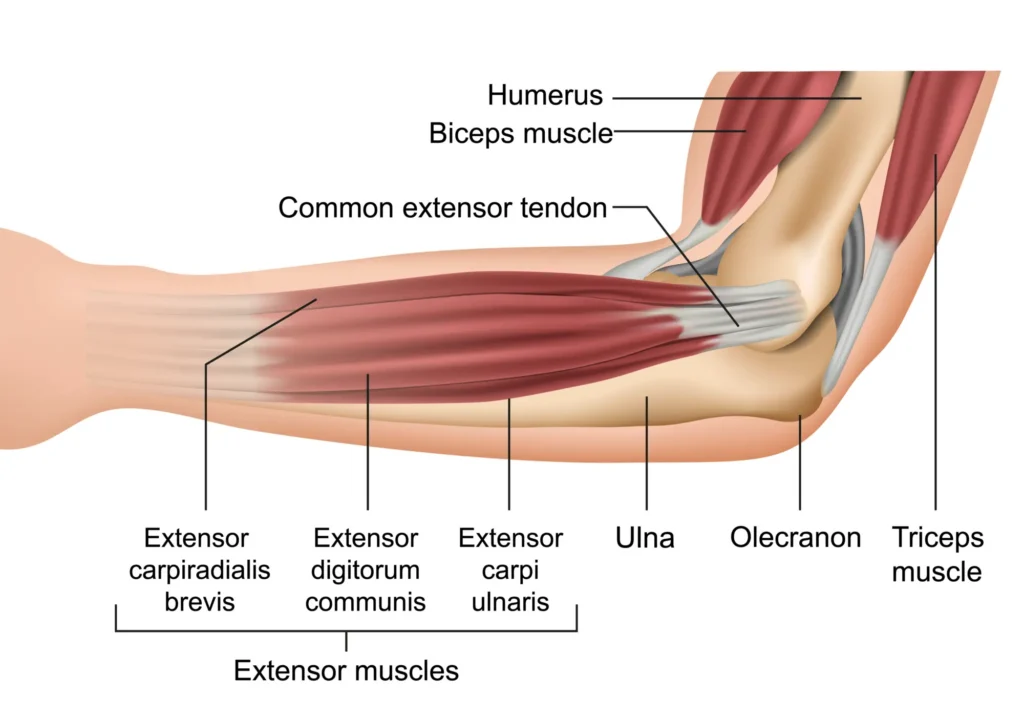
The elbow connects the humerus (upper arm) to the radius and ulna (forearm bones) and functions as both a hinge and a pivot joint. That combination allows the arm to bend and straighten while also rotating the forearm.
The medial (inner) side of the elbow is stabilized primarily by the ulnar collateral ligament (UCL) and the flexor-pronator muscle group. The lateral (outer) side is anchored by the extensor tendons and lateral ligament complex. The posterior compartment, at the tip and back of the elbow, handles compression and extension forces. The ulnar nerve runs through the cubital tunnel on the inner side and is vulnerable to compression or traction, particularly in athletes who perform repetitive bending motions.
Understanding which side of the elbow hurts is often the most useful early diagnostic information, because it narrows down the structures involved before we even do an exam.
Common Elbow Injuries in Athletes
Lateral Epicondylitis (Tennis Elbow)
Tennis elbow involves microtearing and degeneration of the extensor tendons at their attachment on the outer elbow. Despite the name, it’s not exclusive to tennis players. It’s common in climbers, rowers, and anyone performing repetitive grip-intensive work. Patients typically describe aching pain in the outer elbow that worsens with lifting, gripping, or turning the forearm.
Most cases respond well to activity modification, targeted physical therapy, and time. Persistent cases may benefit from additional interventions. Surgery is rarely needed but is an option when conservative treatment has been exhausted.
Medial Epicondylitis (Golfer’s Elbow)
The medial equivalent of tennis elbow, golfer’s elbow involves the flexor-pronator tendons at the inner elbow. It’s common in golfers, but also in climbers, throwing athletes, and workers who grip or flex the wrist repeatedly. Pain is localized to the inner elbow and often worsens with wrist flexion or forearm pronation.
Conservative management is effective for most patients.
UCL Injuries
The ulnar collateral ligament stabilizes the inner elbow against valgus stress, the outward force generated during overhead throwing. Pitchers, javelin throwers, and other overhead athletes are most commonly affected. UCL injuries range from mild sprains to complete tears, and symptoms typically include inner elbow pain during or after throwing, loss of velocity or control, and occasionally a pop at the moment of injury.
Mild to moderate UCL injuries may respond to rest and rehabilitation. High-demand throwing athletes with complete tears may require surgical reconstruction, commonly known as Tommy John surgery.
Cubital Tunnel Syndrome
The ulnar nerve passes through the cubital tunnel on the inner side of the elbow, and in athletes who repeatedly flex the elbow, especially overhead throwers and cyclists, this nerve can become irritated or compressed. Symptoms include numbness and tingling in the ring and small fingers, weakness in grip, and sometimes aching along the inner elbow or forearm.
Mild cases respond to activity modification, splinting at night, and physical therapy. Persistent or worsening nerve symptoms may require surgical decompression.
Distal Biceps Tendon Rupture
A rupture of the distal biceps tendon typically happens during a sudden, forceful pulling motion. Weightlifters, climbers, and contact athletes are particularly vulnerable. The characteristic presentation is a sudden pop, pain at the front of the elbow, and visible bruising, often with a change in the contour of the forearm muscle. Strength with forearm supination is significantly reduced.
Surgical repair may be recommended for active patients who want to restore full strength. Recovery involves a period of bracing followed by progressive rehabilitation.
Diagnosis
Diagnosing an elbow injury starts with a careful history and physical exam. Understanding the sport, the mechanism of pain, and exactly where and when it hurts narrows the possibilities considerably before any imaging is ordered.
X-rays are useful for ruling out bony injuries, loose bodies, and calcification. MRI, sometimes with contrast, provides the clearest view of ligament and tendon integrity and is typically ordered when I need to confirm a UCL tear or assess tendon damage. Ultrasound can be useful for dynamic assessment of tendon and nerve structures.
My Approach to Treatment
The treatment plan for any elbow injury in an athlete depends on three things: what structure is involved, how severely it’s injured, and what the athlete needs to get back to. I don’t treat every tendon problem the same way, and I don’t apply a single recovery timeline to every sport.
For most tendon and nerve conditions, non-surgical treatment is the starting point. That means activity modification, a structured physical therapy program that targets the affected structure specifically, and time. Athletes often want to continue training in some capacity, and where possible, I try to build a plan that allows modified activity rather than complete rest, because the patients who stay engaged in some form of training tend to return to full sport faster.
Surgical treatment is reserved for injuries that don’t respond to conservative care, or for structural problems, like a complete UCL tear or a distal biceps rupture in an active patient, where the evidence supports repair as the more reliable path to full recovery.
Summary
Elbow injuries are common in athletes, and they’re also among the more manageable orthopedic problems when they’re caught early and treated accurately. The most consistent mistake I see is athletes waiting too long to get evaluated, either because the symptoms seem minor or because they don’t want to hear that they need time off.
If you’re an athlete in the Portland area dealing with elbow pain that hasn’t resolved with rest, or symptoms that keep returning when you go back to your sport, an evaluation can help clarify exactly what’s going on and what the most practical path forward looks like.
You can request an appointment online or call the office at (503) 656-0836.
Frequently Asked Questions
How do I know if my elbow pain is serious?
Pain that persists beyond a few days of rest, recurs every time you return to your sport, involves numbness or tingling in the hand, or follows a sudden pop or injury warrants evaluation. Most elbow problems are more manageable when addressed early.
Can I keep training with elbow pain?
It depends on the injury. Some conditions allow modified training while healing progresses; others require a period of complete rest from the aggravating activity. Training through pain without knowing the diagnosis is one of the more common ways athletes convert a minor injury into a more significant one.
Do all UCL tears require Tommy John surgery?
No. Mild to moderate UCL sprains and some partial tears can be managed without surgery, particularly in non-throwing athletes or those with lower athletic demands. Surgical reconstruction is most often recommended for competitive overhead athletes with complete tears who want to return to high-level throwing. New repair techniques are also promising for the right patient with a specific type of tear.