
If you’ve been dealing with a nagging ache on the outside of your elbow, you may be dealing with tennis elbow. However, here’s something that surprises a lot of patients: the discomfort doesn’t always stay put. Many people start noticing pain that seems to travel. A common question I hear in my practice is, “Can tennis elbow cause shoulder pain?” Whether you’re an athlete, someone who works with their hands, or just dealing with the demands of everyday life, understanding the connection between these two areas may help you take the right steps toward recovery.
Key Takeaways
- Tennis elbow is an overuse condition affecting the tendons on the outer side of the elbow, and it may contribute to shoulder pain through several different mechanisms.
- The body responds to elbow pain by compensating, often shifting extra work to the shoulder, which can lead to muscle fatigue, tightness, and discomfort over time.
- Referred pain from the elbow region may sometimes be felt in the upper arm or shoulder, even without any direct shoulder injury.
- Most cases respond well to conservative treatment when addressed early. Seeking an evaluation sooner rather than later may help you avoid more complex problems down the line.
What Is Tennis Elbow?
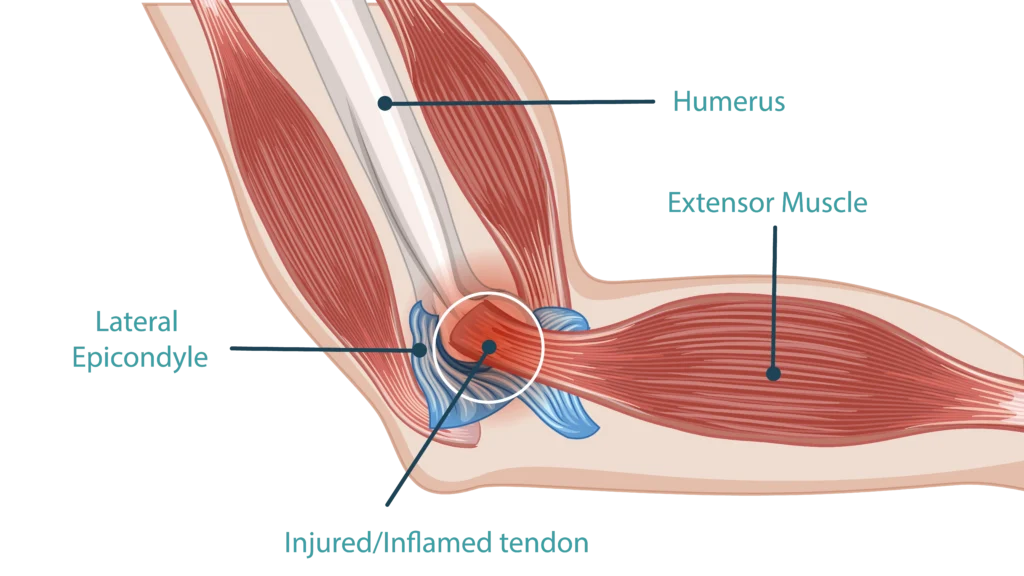
Tennis elbow is an overuse injury. It develops gradually when the tendons attaching your forearm muscles to the lateral epicondyle, the bony prominence on the outer side of your elbow, become stressed, irritated, and eventually damaged. These tendons play a key role in controlling the wrist and hand during gripping and lifting movements.
Despite what the name implies, you don’t have to play tennis to develop this condition. It’s extremely common among painters, carpenters, plumbers, desk workers, cooks, and anyone who performs repetitive arm or wrist movements on a regular basis. The signature symptom is pain or burning along the outside of the elbow. Grip weakness often follows, making ordinary tasks, such as turning a key, lifting a cup, or shaking hands, feel surprisingly difficult.
The onset is usually gradual. Most patients can’t point to a single moment of injury. Instead, tennis elbow symptoms may build steadily over weeks or months of repetitive activity, small micro-tears accumulating in the tendon tissue until the pain becomes hard to ignore.
Can Tennis Elbow Cause Shoulder Pain?
So, can tennis elbow cause shoulder pain? Tennis elbow itself doesn’t typically cause structural damage to the shoulder joint. However, that doesn’t mean the shoulder is unaffected. There are several well-recognized pathways through which elbow pain may contribute to discomfort that travels up the arm toward the shoulder.
Referred Pain
One important concept here is referred pain. This is when the sensation of pain is experienced in a different area than where the actual problem exists. The nervous system isn’t always precise in localizing discomfort, and lateral epicondylitis may sometimes produce a dull, radiating ache that extends up the forearm and occasionally into the upper arm.
The lateral epicondyle is located near structures such as the radial nerve, and irritation in the area may occasionally contribute to symptoms that are not precisely localized. This doesn’t happen in every case, and not everyone with tennis elbow will feel it in the shoulder.
How Your Body Compensates
When your elbow hurts, your brain begins making adjustments, often without you being aware of it. You start holding your arm differently. You shift certain movements. You unconsciously avoid the positions that provoke pain. And over time, those subtle changes in how you use your arm can transfer extra demand to the shoulder.
Think about it this way: if gripping or extending your wrist causes pain, you may start relying more heavily on your shoulder to initiate or complete movements. Muscles like the deltoid, rotator cuff, and the muscles around the shoulder blade may pick up the slack that the elbow can no longer handle. Over weeks or months of this kind of compensation, shoulder fatigue, tightness, and pain can develop, not because the shoulder itself is injured, but because it’s being asked to do more than it was built for in that context.
The Kinetic Chain
Your arm functions as part of a kinetic chain, a connected system where motion and mechanics in one area directly influence all the others. The shoulder, elbow, wrist, and hand are linked through bones, muscles, tendons, and nerves. When one link in that chain is compromised, the others have to adapt.
In a healthy arm, forces generated at the shoulder travel efficiently through the elbow and into the hand. When the elbow is painful and movement becomes guarded or restricted, that flow gets disrupted. Athletes are especially vulnerable to these chain-reaction effects. A tennis player or golfer who begins favoring a sore elbow may unconsciously alter their stroke mechanics, placing the rotator cuff or biceps tendon under greater-than-normal stress. Over time, that modified movement pattern may start producing shoulder symptoms of its own.
When Both Issues Appear Together
It’s also worth noting that tennis elbow and shoulder problems can exist entirely independently and simply happen to occur at the same time. Repetitive overhead athletes, for example, may stress both the elbow and shoulder through their training or sport. In those situations, neither condition is necessarily causing the other. Both are responding to the same pattern of overuse.
This is one of the reasons a thorough clinical evaluation matters so much. If you’re presenting with shoulder pain and also have tennis elbow, the key question is whether one is driving the other, or whether both need to be addressed on their own terms.
Symptoms That May Signal a Connection
Knowing what to look for can help you communicate more effectively with your doctor. If you have tennis elbow and are wondering whether your shoulder symptoms might be related, pay attention to the following:
- A dull, traveling ache that starts at the outer elbow and seems to move up the arm
- Shoulder stiffness or fatigue that developed around the same time your elbow symptoms began
- Weakness when reaching overhead, across your body, or carrying objects with your arm extended
- Tightness in the upper arm or biceps region that wasn’t there before
- Difficulty with tasks that require both grip strength and shoulder stability, like lifting a bag or pushing a door open
Getting an Accurate Diagnosis
Because both are complex joints surrounded by tendons, ligaments, nerves, and muscles, a thorough evaluation from a shoulder and elbow specialist supports an accurate diagnosis. A physical exam is typically the starting point, during which your doctor will assess range of motion, strength, and pain response at both joints. Your activity history, occupation, and any recent changes in arm use will also factor into the picture.
Imaging may be recommended as part of the workup. X-rays can help rule out bone-related problems. Ultrasound or MRI may offer a closer look at tendon and soft tissue health. In some cases, nerve conduction studies or EMG testing may be considered if there’s concern that nerve irritation is contributing to radiating symptoms.
The goal is to identify all contributing factors, not just treat the loudest symptom. It’s worth knowing that some patients get relief from their elbow but continue to struggle with shoulder pain because the shoulder issue was never directly addressed.
Treatment Options
Your treatment plan will likely depend on the specific issues identified during your evaluation, but it may include some combination of the following approaches.
Rest and activity modification. Reducing or temporarily avoiding the activities driving your symptoms is often the first step. The goal isn’t complete inactivity; it’s being strategic about where and how much stress you place on the arm during recovery.
Physical therapy. A skilled physical therapist can work on both the elbow and the shoulder, addressing flexibility, strength, and movement patterns simultaneously. They may also help identify and correct the compensation habits that have been building up over time.
Bracing. A counterforce brace worn around the forearm may help reduce the load placed on the lateral epicondyle during activity, providing some relief while the tendon heals.
Injections. For patients who aren’t making adequate progress with conservative care, platelet-rich plasma (PRP) injections may be considered. These aim to promote healing at the site of injury.
Targeted shoulder treatment. If shoulder pathology is identified separately, such as rotator cuff irritation, bursitis, or biceps tendon involvement, those conditions may require their own focused treatment plan. In some cases, managing both simultaneously may be the most efficient approach.
Surgery. Surgical intervention for tennis elbow is relatively uncommon. It’s typically considered only when symptoms persist despite thorough conservative management. Shoulder surgery follows a similar threshold; it becomes a conversation only if structural damage is present and non-surgical options have been exhausted.
Summary
Can tennis elbow cause shoulder pain? The connection may be more common than many patients expect. While tennis elbow is primarily an elbow condition, the way the body responds to that pain, through referred discomfort, compensatory movement patterns, and the mechanics of the kinetic chain, may extend its effects into the shoulder. If you’re managing tennis elbow and starting to notice shoulder symptoms, it’s worth discussing both with a specialist who can evaluate the full picture.
Frequently Asked Questions
Can tennis elbow directly damage the shoulder joint?
Tennis elbow itself does not typically cause structural damage to the shoulder. However, the way you compensate for elbow pain over time can place added stress on shoulder muscles and tendons, potentially leading to pain, tightness, or inflammation in that area.
Can tennis elbow and shoulder pain be treated at the same time?
In many cases, yes. Your treatment plan should be tailored to the specific findings from your evaluation rather than approached as a one-size-fits-all protocol.
Does tennis elbow go away on its own?
Milder cases sometimes improve with rest, activity modification, and time. However, more persistent or severe cases often benefit from guided treatment. Allowing symptoms to continue without intervention may allow them to become chronic, which can make recovery more difficult and prolonged.
Is surgery usually required for tennis elbow?
Surgery is not commonly required for tennis elbow. The vast majority of cases respond to conservative treatment, including rest, physical therapy, bracing, and in some situations, injections. Surgical options are typically only considered when symptoms persist despite comprehensive non-surgical management.