
Medically reviewed by Nathan Orvets, MD | Reviewed August 2026
When I evaluate patients with numbness or tingling in the ring and pinky fingers, one of my first goals is to determine exactly where the ulnar nerve is being compressed. Although cubital tunnel syndrome is a common cause, it’s not the only one. The ulnar nerve can become entrapped at several points along its path, including the wrist, forearm, or even farther up the arm. In this post, I’ll explain how I evaluate ulnar nerve entrapment, why the location matters, and how that diagnosis guides treatment in my Tualatin and Oregon City patients.
Key Takeaways
- Ulnar nerve entrapment refers to compression of the ulnar nerve anywhere along its path, and cubital tunnel syndrome at the elbow is just the most common site, not the only one.
- Numbness or tingling in the ring and pinky fingers is the usual symptom, but where that compression is actually happening changes the recommended treatment.
- Many cases improve with activity changes, splinting, and nerve gliding exercises before surgery is ever discussed.
- Surgical decompression becomes a reasonable option when symptoms are persistent, worsening, or when there are signs of muscle weakness or wasting in the hand.
What Is Ulnar Nerve Entrapment?
The ulnar nerve starts near the shoulder, travels down the inside of the upper arm, passes behind the elbow, and continues into the forearm and hand. It supplies feeling to the ring and pinky fingers and controls many of the small muscles that give the hand its fine motor control and grip strength. Because the nerve runs so close to the skin’s surface at several points along that path, it’s especially vulnerable to pressure and stretching.
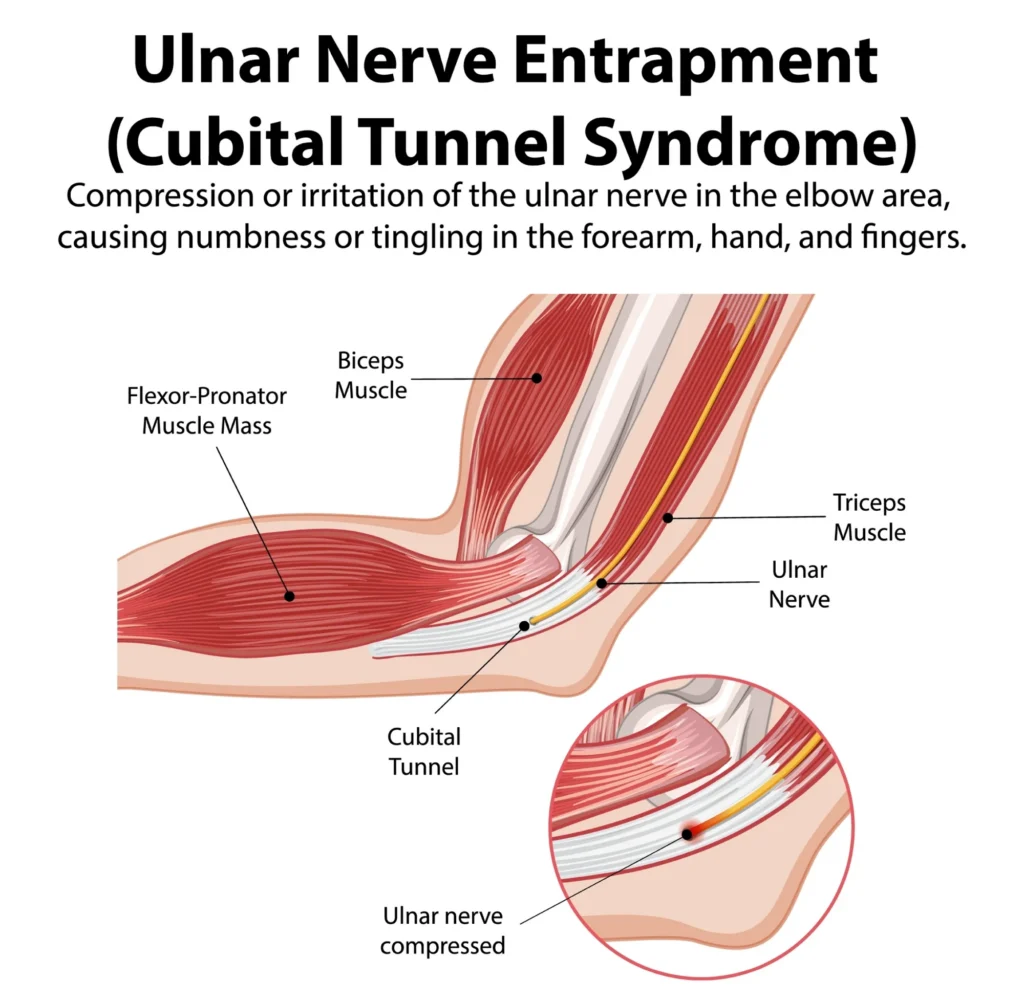
Ulnar nerve entrapment happens when that nerve gets compressed, irritated, or stretched at one of those vulnerable points. Cubital tunnel syndrome, compression at the inner elbow, is the most frequently diagnosed form. It is not, however, the only location where entrapment can occur, and treating every case as if it’s automatically a cubital tunnel problem may lead to a treatment plan that misses the actual source of the pressure.
Beyond the Elbow: Other Common Entrapment Sites
At the wrist, the ulnar nerve can become compressed in a space called Guyon’s canal, sometimes from repetitive pressure such as long hours of cycling, prolonged use of vibrating power tools, or a cyst pressing on the nerve. Symptoms here tend to affect sensation in the ring and pinky fingers similarly to cubital tunnel syndrome, but often spare part of the hand’s back surface, which can be a useful clue in narrowing down the location.
Higher up, near the underarm and upper arm, the nerve can occasionally be compressed by muscle bands or anatomical variations that aren’t present in every patient. This is far less common than cubital tunnel or Guyon’s canal compression, but it’s a reason a thorough physical exam matters before jumping to a diagnosis.
Pinpointing the exact site of compression changes both the recommended treatment and, if surgery becomes necessary, exactly where that surgery needs to happen.
Recognizing the Symptoms
Symptoms of ulnar nerve entrapment often build gradually rather than appearing all at once. Numbness or tingling in the ring and pinky fingers is usually the first sign patients notice, frequently worse at night or after activities that involve prolonged elbow bending, like talking on the phone or sleeping with the arm curled up. As compression becomes more significant, some patients develop weakness in their grip or notice their hand tiring more quickly during activities that used to feel effortless.
In more advanced or long-standing cases, visible muscle wasting can develop in the hand, particularly between the thumb and index finger or along the outer edge of the palm. This is a sign that the nerve compression has been present long enough to affect the muscle itself, and it’s a finding that generally moves the conversation toward surgical evaluation sooner rather than later.
What About Carpal Tunnel Syndrome?
Ulnar nerve entrapment and carpal tunnel syndrome get confused, since both can cause numbness and tingling in the hand. The difference comes down to which nerve is involved and which fingers are affected. Ulnar nerve entrapment typically causes symptoms in the ring and pinky fingers, sometimes along the outer edge of the palm. Carpal tunnel syndrome, by contrast, involves the median nerve and usually affects the thumb, index, and middle fingers instead.
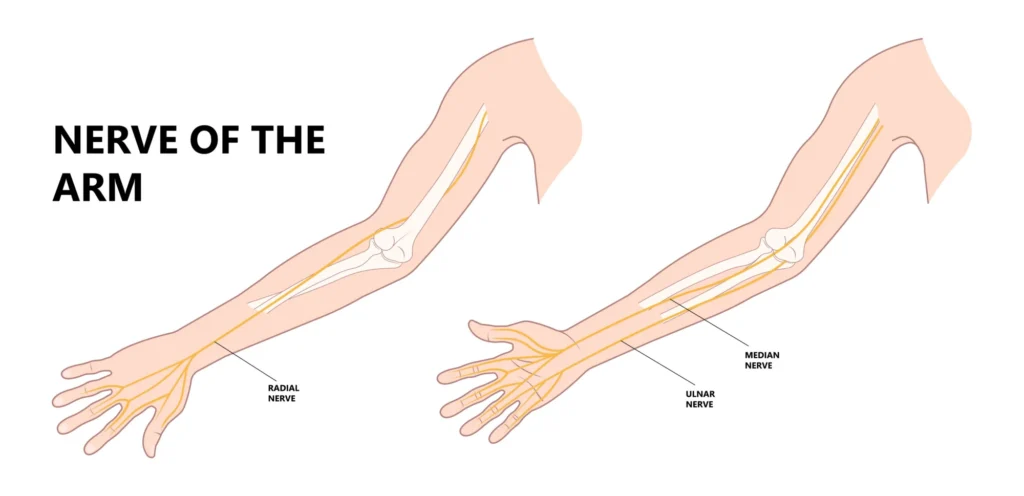
The triggers can differ too. Ulnar nerve symptoms tend to flare with prolonged elbow bending, while carpal tunnel symptoms are more often linked to repetitive wrist motion or extended computer and phone use. Paying attention to which fingers are affected and what position brings symptoms on can help narrow down which nerve is involved before you even get to the exam room, though a physical exam is still the best way to confirm it.
How Ulnar Nerve Entrapment Is Diagnosed
Diagnosis usually starts with a physical exam. Tapping over the nerve at the elbow, wrist, or other suspected sites can reproduce the tingling sensation, a finding doctors call a positive Tinel’s sign, and it can help confirm where the compression is happening. A doctor will also check grip strength, look for muscle wasting in the hand, and test how well the fingers can move independently of one another, since fine motor control is often affected before a patient notices any obvious weakness.
When the picture isn’t clear from the exam alone, nerve conduction studies and electromyography may be used to measure how well electrical signals travel along the ulnar nerve and pinpoint exactly where the slowdown occurs. These tests aren’t necessary for every patient, but they become valuable when symptoms are ambiguous, when more than one site of compression is suspected, or when surgery is being considered and the surgical team needs to know precisely where to operate. Imaging, such as ultrasound or MRI, is sometimes added if a structural cause like a cyst or anatomical variation is suspected.
What I See in My Patients
One pattern I notice in my practice is that people tend to wait a long time before bringing this up. Many patients tell me they assumed the tingling was just “sleeping funny” or a normal part of getting older, sometimes for a year or more before they mention it. By the time some of these patients get to me, there’s already measurable weakness in the hand, which changes the conversation from watching and waiting to talking seriously about decompression surgery.
I also see a fair number of patients, particularly cyclists and people who spend long hours leaning on a desk or armrest, who improve just by changing a habit. A cyclist who adjusts their handlebar position or a desk worker who stops resting their elbow on a hard surface all day sometimes sees real improvement within a matter of weeks, without ever needing a brace or a referral to physical therapy.
My Approach to Treatment
My approach starts with figuring out exactly where the compression is happening before assuming it’s automatically the cubital tunnel. That distinction matters, because a treatment plan built around the wrong location won’t relieve the pressure that’s actually causing the symptoms. For most patients with mild to moderate symptoms, I start conservatively, with activity modification, nighttime splinting to keep the elbow from bending too far, and nerve gliding exercises that help the nerve move more freely through its surrounding tissue.
Surgery isn’t my first move, but I don’t wait indefinitely either. If a patient has persistent symptoms after a genuine trial of conservative care, or if there’s any sign of muscle weakness or wasting, I talk with them about surgical decompression sooner rather than later. Nerve tissue that’s been compressed for a long time doesn’t always recover fully even after the pressure is relieved, so I’d rather intervene while recovery potential is still strong than wait until the window has narrowed.
Summary
Ulnar nerve entrapment covers more ground than cubital tunnel syndrome alone, even though the elbow remains the most common site of compression. The wrist, forearm, and occasionally the upper arm can all be involved, and figuring out exactly where the pressure is happening is the key to choosing the right treatment. Most cases respond well to conservative measures like activity changes, splinting, and nerve gliding exercises, though persistent symptoms or hand weakness are signals that it’s time to talk about surgical decompression. If you’ve been living with numbness or tingling in your ring and pinky fingers, the next step is a hands-on exam and, if needed, nerve testing to find out exactly where your ulnar nerve is being compressed. You can request an appointment to get that process started.
Frequently Asked Questions
Is cubital tunnel syndrome the same thing as ulnar nerve entrapment?
Cubital tunnel syndrome is the most common form of ulnar nerve entrapment, but it’s not the only one. The ulnar nerve can also be compressed at the wrist or, less commonly, higher up in the arm.
Can ulnar nerve entrapment get better without surgery?
Yes, many cases improve with activity modification, nighttime splinting, and nerve gliding exercises, especially when caught early before significant weakness develops.
When does ulnar nerve entrapment require surgery?
Surgery becomes a stronger consideration when symptoms persist despite conservative treatment, or when there are signs of muscle weakness or visible wasting in the hand, since these suggest the nerve compression has become more significant.
What activities commonly contribute to ulnar nerve entrapment?
Prolonged elbow bending, resting the elbow on a hard surface for long periods, cycling with certain handlebar positions, and repetitive vibrating tool use are all activities I commonly see associated with ulnar nerve symptoms.