Medically reviewed by Nathan Orvets, MD | Reviewed July 2026
“Is shoulder arthroscopy actually worth it, or should I just keep managing this on my own?” I get some version of this question often. Usually, it comes from patients who’ve been dealing with shoulder pain for months and are weighing whether surgery makes sense. It’s a fair question. The honest answer is that it depends on your specific condition, how much it’s affecting your life, and what you’ve already tried. In this post, I’ll walk through what shoulder arthroscopy actually involves, when it tends to be worth considering, and how I help patients think through that decision.
Key Takeaways
- Shoulder arthroscopy is a minimally invasive surgery used to diagnose and treat a range of shoulder conditions through small incisions.
- It’s generally considered after conservative treatments haven’t provided enough relief, not as a first step.
- Recovery may be shorter than with open surgery, though it still requires real time and commitment.
- Whether it’s “worth it” depends on your specific diagnosis, activity goals, and how much your symptoms are limiting you.
What Is Shoulder Arthroscopy?
Shoulder arthroscopy is a surgical technique where I use a small camera, called an arthroscope, along with narrow instruments. These go in through a few small incisions around the shoulder. Instead of one larger incision, the joint is accessed through openings usually smaller than half an inch. This lets me see inside the joint on a monitor and treat a range of problems without fully opening up the shoulder.
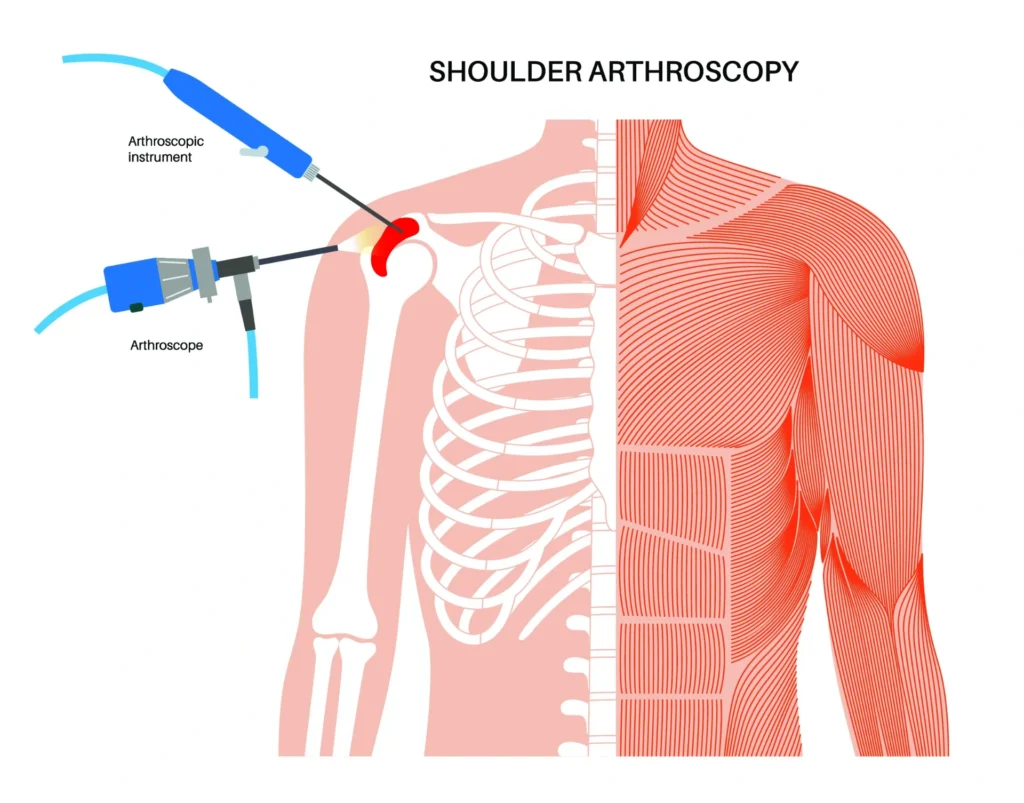
It’s not a single procedure so much as a technique used for several different problems. I commonly use it for rotator cuff repairs, treating shoulder impingement through subacromial decompression, repairing labral tears, addressing certain forms of shoulder instability, and treating some biceps tendon issues.
How Shoulder Arthroscopy Compares to Open Surgery
Compared to traditional open surgery, arthroscopy generally involves smaller incisions and less disruption to the surrounding muscle. In some cases, it means a quicker initial recovery too. Many patients also report less pain in the first few weeks after surgery. That said, arthroscopy isn’t always the better choice in every situation. Certain complex reconstructions or severe injuries may still be better suited to an open approach. I’ll always recommend whichever technique gives you the best chance at a durable result.
When Shoulder Arthroscopy Tends to Be Worth It
In my experience, shoulder arthroscopy tends to be most worthwhile for patients who’ve already given conservative treatment a chance. That may include physical therapy, activity modification, and sometimes injections. It can also be the right call when imaging shows a clear structural problem, such as a rotator cuff tear or labral tear, that’s unlikely to heal well on its own.
Patients who are highly active often find the recovery process worth it. Whether that’s through sports, physically demanding work, or simply an active lifestyle they want to protect, surgery may restore function that’s been limiting them for months. On the other hand, patients with mild symptoms that haven’t significantly affected daily life may be better served waiting, especially if they haven’t tried a full course of conservative care.
What I See in My Patients
The patients who tend to feel most satisfied after shoulder arthroscopy are the ones who came in with realistic expectations. They also tend to have a clear sense of what they wanted to get back to. I’ve had patients who simply wanted to sleep through the night again without shoulder pain. Others wanted to get back to competitive tennis or overhead work. Both are valid goals, but they call for different conversations about timeline and expected outcome.
I also notice that patients who commit fully to the physical therapy portion of recovery tend to do noticeably better. This holds up compared to those who treat surgery as the finish line rather than the starting point. The surgery addresses the structural problem, but the rehab is what restores the maximum function around it.
Weighing the Decision
A few questions tend to guide this conversation in my office. How much is your shoulder actually limiting you day to day? Have you given non-surgical treatment a fair, consistent trial? Does your imaging show a specific problem that arthroscopy could realistically fix? What are you hoping to get back to, and does that align with what surgery can reasonably offer?
There’s no universal answer to whether shoulder arthroscopy is worth it. For some patients, it’s a clear yes. For others, especially those with mild symptoms or unexhausted conservative options, waiting is the more sensible choice for now. My job is to help you sort out where you fall. That decision should rest on your exam, your imaging, and your goals, rather than a one-size-fits-all answer.
What Recovery Generally Looks Like
Recovery varies quite a bit depending on the specific procedure. Many patients wear a sling for a period of a few weeks after surgery. Physical therapy typically begins within that early window, starting with gentle motion and building toward strengthening over the following months. Simpler procedures, like a subacromial decompression, often allow a faster return to daily activities. A rotator cuff repair, by contrast, requires more time, since the tendon itself needs to heal into bone. I go over the expected timeline in detail for your specific procedure during your consultation, since it genuinely varies from patient to patient.
Summary
Shoulder arthroscopy can be genuinely worth it for the right patient and the right problem, particularly once conservative treatment hasn’t provided enough relief. It isn’t a decision to make in isolation, though. It works best when it’s based on a clear diagnosis and a real conversation about your goals. If you’ve been going back and forth on whether surgery makes sense for your shoulder, I’d encourage you to come in for an evaluation. We can look at your imaging together and talk through whether it’s the right next step for you.
Frequently Asked Questions
Is shoulder arthroscopy painful afterward?
Some discomfort is normal in the days following surgery, and we will discuss a pain management plan ahead of time. Most patients find that pain improves steadily over the first couple of weeks, especially once the initial swelling settles.
Will I need physical therapy after shoulder arthroscopy?
In almost all cases, yes. Physical therapy plays a role in restoring motion and strength after surgery. Skipping or rushing through it tends to lead to a less complete recovery.
How do I know if I should try more conservative treatment before considering surgery?
If you haven’t yet completed a genuine course of physical therapy, activity changes, and possibly an injection, that’s usually the right place to start. If those approaches haven’t helped after a reasonable trial, or if imaging shows a clear structural issue, that’s when surgery becomes a more serious consideration.