
Medically reviewed by Nathan Orvets, MD | Reviewed July 2026
Baseball season brings a familiar wave of patients into my clinic. A lot of them are dealing with the same general problem: throwing elbow injuries. I see this in youth pitchers, high school shortstops, weekend players, and everyone in between. Baseball asks a lot of the elbow. Because throwing is so repetitive and involves violent levels of force, small issues can build into bigger ones if they’re ignored. In this post, we’ll take a close look at throwing elbow injuries in baseball players, including why certain positions and age groups face more risk, what tends to drive throwing elbow injuries over a season, and what I generally recommend for treatment and prevention.
Key Takeaways
- Pitchers and catchers face the highest volume of throwing stress, but any position can develop a throwing elbow injury.
- Pitch counts and rest days matter more than most players realize, especially for younger athletes.
- Fatigue is one of the biggest risk factors. Many injuries happen when a player keeps throwing while tired.
Why Baseball Is Hard on the Elbow
Throwing a baseball puts a tremendous amount of force through the elbow in a fraction of a second. During the cocking and acceleration phases of a throw, the inner side of the elbow gets pulled apart. At the same time, the outer side gets compressed. It’s a lot to ask of a joint that size, and it happens with every single pitch.
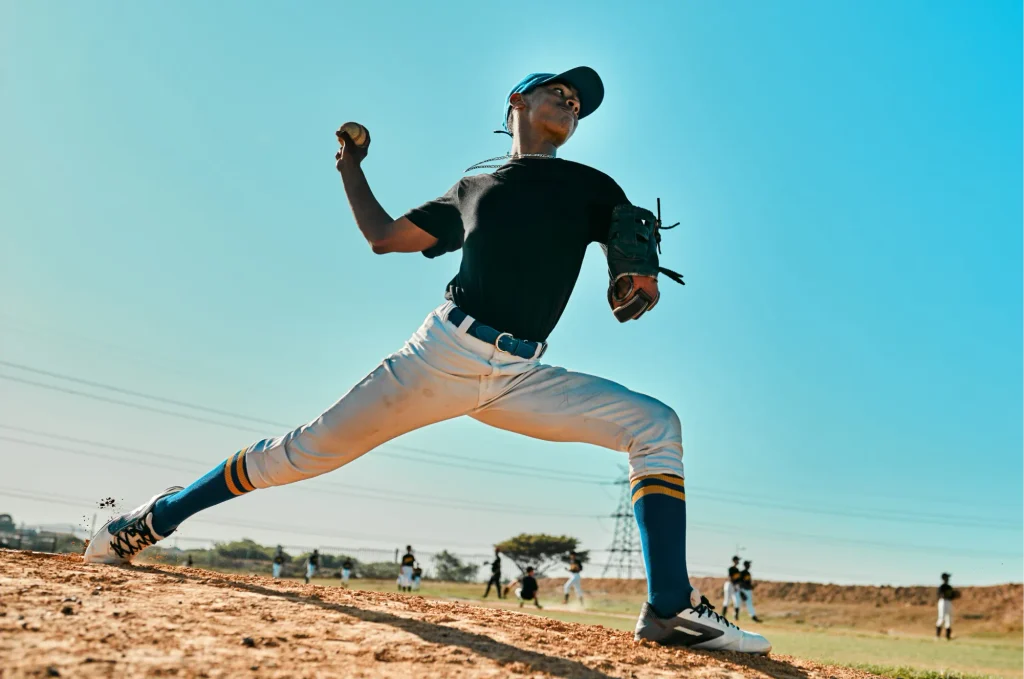
A single throw usually isn’t the problem. The real issue is accumulation. Hundreds or thousands of throws over a season, sometimes across multiple teams or showcases, gradually wear down the structures inside the elbow. This is why throwing elbow injuries in baseball players often build slowly rather than appearing after one specific moment.
Which Positions Carry the Most Risk
Pitchers
Pitchers throw the most pitches at the highest effort level. That makes them the group I see most frequently for throwing elbow injuries. The ulnar collateral ligament (UCL) takes the brunt of this stress. It’s the structure behind the well-known “Tommy John surgery,” a procedure used to repair a torn UCL. Velocity, pitch volume, and pitch type all factor into a pitcher’s individual risk.
Catchers
Catchers throw far more often than people realize. Between warm-up throws, pickoffs, and throws back to the pitcher, their overall volume across a season can rival some pitchers. It just tends to get less attention.
Position Players
Infielders and outfielders throw less overall than pitchers, but that doesn’t make them immune. A hard, off-balance throw from the outfield can still stress the elbow significantly. The same goes for a rushed throw across the infield, especially if a player’s mechanics or conditioning aren’t where they should be.
Age Matters More Than People Expect
Youth and adolescent athletes deserve special attention, in my opinion, because their elbows are still developing. The growth plates in a young thrower’s elbow are more vulnerable than mature bone. Repetitive stress on them can lead to a condition called Little Leaguer’s elbow. Most youth baseball organizations now publish pitch count and rest guidelines for this exact reason. I think following them closely is one of the most effective things a young player, parent, or coach can do.
Adult recreational players face a different set of factors. Many haven’t thrown competitively in years before picking the sport back up. Their throwing tissue simply isn’t conditioned for the demands of a full season. I often see this group show up with symptoms early in the season, before their arm has had a real chance to build back up.
What I See in My Patients
A pattern I notice constantly, across ages and positions, is players pushing through fatigue. This happens especially late in a game or during a tournament weekend, often because a player doesn’t want to come out. Fatigue changes throwing mechanics in subtle ways, sometimes without the player even noticing. Those small mechanical shifts can place extra load directly on the elbow. In my experience, a meaningful number of the more serious throwing elbow injuries I treat trace back to a stretch of throwing while tired, rather than a single bad pitch.
I also see plenty of players and parents who wait too long to bring up elbow discomfort. Sometimes it’s out of concern about losing playing time. I understand that concern, but in most cases I see, early evaluation tends to lead to a shorter recovery, not a longer one.
Prevention Strategies I Recommend
When it comes to throwers, I always recommend following prevention strategies. A few habits may make a real difference:
- Follow age-appropriate pitch count and rest guidelines, and treat them as a mandatory, not a suggestion to push past.
- Build a proper throwing progression at the start of each season instead of ramping up too quickly.
- Address fatigue proactively. Coming out of a game before pain starts is almost always the better choice.
- Train the shoulder, core, and hips, since throwing power comes from the whole body, not just the arm.
- Report elbow discomfort early rather than playing through it, especially in younger athletes with open growth plates.
- Rest the elbow during the off season rather than continuing to throw all year.
These do not guarantee that you won’t get a throwing-related injury, but they do support your elbow health and may help lower the risk.
When I Recommend an Evaluation
Not every sore elbow after a game needs an urgent visit. But a few signs usually mean it’s worth getting checked sooner rather than later. Pain that lingers for more than a few days, a noticeable drop in velocity or accuracy, tingling or numbness into the ring and pinky fingers, or a specific “pop” felt during a throw are all reasons I’d want to see a player in clinic. For younger athletes, I tend to have an even lower threshold. Catching a growth plate issue early can prevent a much bigger problem later.
When it comes to treatment for elbow pain when throwing, many throwing elbow injuries respond well to a period of rest, activity changes, and physical therapy focused on rebuilding strength and mechanics. Surgery is usually reserved for more serious tears that don’t improve with conservative care, particularly in athletes hoping to return to competitive throwing.
Summary
Throwing elbow injuries in baseball players are common. To help prevent throwing injuries, prioritize the right approach to pitch counts, rest, and conditioning. If you or your player are dealing with elbow discomfort that isn’t settling down, I’d encourage you to schedule a visit. The same goes if you simply want a plan to protect a young pitcher’s arm for the season ahead. We can put together the right plan for your specific situation.
Frequently Asked Questions
How many pitches is too many for a youth pitcher?
It depends on age, but most youth baseball organizations publish specific pitch count limits along with required rest days between outings. These guidelines exist because younger elbows are more vulnerable to overuse injury. Following them closely is one of the best prevention steps available.
Can position players get throwing elbow injuries too?
Yes. Pitchers and catchers see the highest volume of throwing, but infielders and outfielders can still develop throwing elbow injuries. This is especially true with hard or off-balance throws made without proper mechanics or conditioning.
Is it ever okay to play through elbow pain?
Generally, I don’t recommend playing through elbow pain. Mild, brief soreness that resolves quickly with rest is common. But pain that lingers, worsens, or comes with numbness or tingling is a signal to get evaluated rather than push through.